 Summarize this Article with AI
- A whole-house carbon filter treats all water entering a building, so it must be sized for peak flow, not average use.
- Empty bed contact time sets the carbon volume, and chloramine needs far more contact time than free chlorine.
- Tank diameter and bed depth must keep flow velocity and pressure drop within sensible limits.
- A sediment pre-filter and a planned backwash protect the bed from fouling and channelling.
- Carbon choice, coconut shell, coal or catalytic, should follow the water chemistry, not the price alone.
- Bypass valves, sampling points and a written change-out plan turn a filter into a system you can maintain.
- What Is a Whole-House Carbon Water Filter?
- Start With the Water: What You Are Designing For
- Sizing by Peak Flow and Contact Time
- Choosing the Tank, Bed Depth and Flow Velocity
- Selecting the Carbon: Coconut Shell, Coal and Catalytic
- Pre-Filtration, Backwash and Bypass Design
- Installation Layout and Hydraulic Considerations
- Operating Life, Breakthrough and Maintenance
- Commissioning, Testing and Common Mistakes
- Who Installs Whole-House Carbon Systems?
- Related Reading
- Frequently Asked Questions
A whole-house carbon water filter sounds simple: put a tank of carbon where the water enters the building and every tap delivers better water. In practice the difference between a system that works for years and one that disappoints within months lies in a handful of design decisions made before anyone buys a tank.
This guide explains those decisions in the order a designer would make them: define the water and the target, size for peak flow and contact time, choose the vessel and the carbon, then plan pre-filtration, backwash and maintenance. It draws on how Western Carbon’s granular carbon for water treatment is specified in practice, and it assumes you are fitting a filter to a house, apartment block, small hotel or similar building. If you want the general background on carbon filters first, read our complete technical guide to carbon filters.
1. What Is a Whole-House Carbon Water Filter?
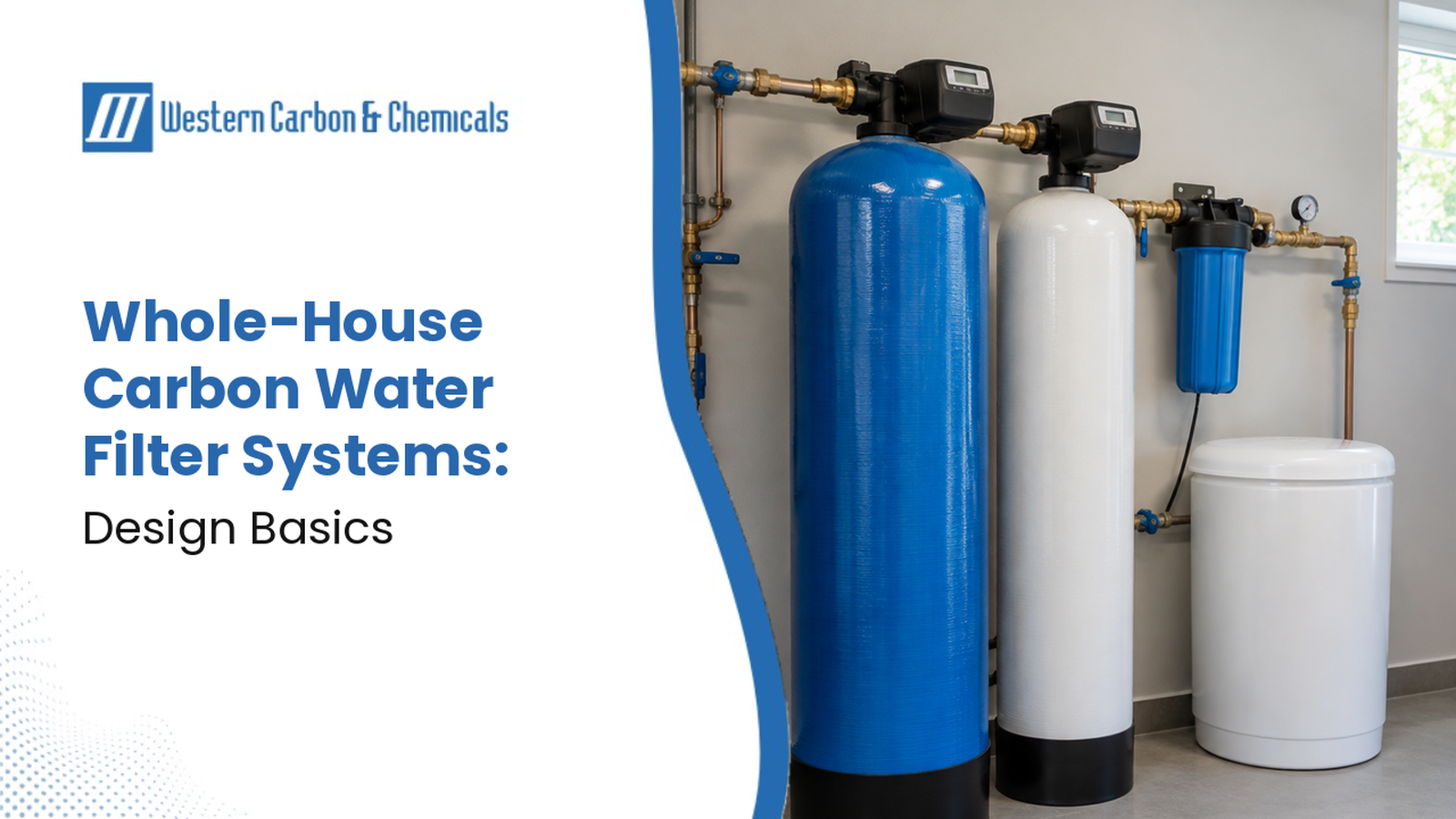
A whole-house filter, often called a point-of-entry system, is installed on the main water line after the meter and before the water heater and branch pipes. Everything the building uses, including showers, laundry and drinking water, passes through it. This contrasts with a point-of-use filter, which treats a single tap or appliance.
The usual reasons to treat at the point of entry are chlorine taste and smell throughout the home, skin and hair dryness attributed to chlorine, protection of appliances and plumbing from chlorine attack, and removal of organic chemicals that can vaporise during showering. The filter itself is typically a fibreglass or steel tank filled with granular activated carbon and fitted with a control valve that handles service and backwash.
What it does not do is treat everything. Carbon does not remove hardness, nitrate or microbes, as covered in our guide to activated carbon in water treatment, so the design starts by being clear about what the filter is there to remove.
2. Start With the Water: What You Are Designing For
Every good design starts with an analysis of the incoming water. Obtain the water quality report from your supplier or test private supplies in a laboratory. Record the disinfectant type and level, total organic carbon if available, hardness, iron and manganese, hydrogen sulphide, pH and temperature.
Free chlorine or chloramine?
This single question changes the design. Free chlorine is removed quickly by almost any carbon. Chloramine, used by many suppliers because it persists in the distribution system, is reduced much more slowly and needs longer contact time or a catalytic carbon. The EPA explanation of chloramines in drinking water describes why suppliers use it, and why users sometimes need additional treatment. Our upcoming guide on catalytic carbon covers the chemistry in more detail. For the broader picture of what is acceptable in drinking water, the WHO drinking water quality guidelines are the usual international reference, and they are a good place to check any compound you are unsure about before you design around it.
Other contaminants that change the design
- Iron and manganese foul carbon, so oxidation and filtration should come first.
- Hydrogen sulphide needs catalytic or impregnated carbon, or an upstream oxidation step.
- High sediment loads need a pre-filter or a multimedia stage.
- Hard water scales valves and heaters and needs separate softening.
Do not size a filter until you know whether the supplier uses chloramine. It can double or triple the carbon volume required.
3. Sizing by Peak Flow and Contact Time
Two numbers drive sizing: the peak flow rate the filter must pass, and the empty bed contact time you need. Peak flow is the highest simultaneous demand, for example a shower, a washing machine and a kitchen tap running together. It is not the daily average, and sizing to average use is the most common cause of undersized systems.
Empty bed contact time, or EBCT, is the carbon volume divided by the flow rate. It is the average time water spends in the carbon bed, and it is the core design parameter because the contaminant has to diffuse into the pores during that time.
A worked example
Suppose a house has a peak demand of 10 US gallons per minute and the water has free chlorine only, for which a design EBCT of about 2 minutes is a reasonable starting point. The carbon volume is 10 gallons per minute multiplied by 2 minutes, which gives 20 gallons. Since one cubic foot holds about 7.5 gallons, that is roughly 2.7 cubic feet of carbon. If the supplier uses chloramine and the design EBCT needs to rise to 6 minutes, the same calculation gives about 8 cubic feet.
These figures are illustrative starting points, and the right EBCT depends on the carbon, the contaminant and the target. A pilot test or supplier data is the sound way to confirm them.
Key point: carbon volume equals peak flow multiplied by EBCT. If you want longer contact time and the flow cannot be reduced, the only answer is more carbon.
4. Choosing the Tank, Bed Depth and Flow Velocity
Once the carbon volume is known, it must be packed into a tank whose dimensions keep the flow behaving well. Two limits matter. Surface loading rate, the flow divided by the tank cross-section, should be moderate so that water spreads evenly through the bed and pressure drop stays acceptable. Bed depth must be enough that the water does not short-circuit through the carbon.
A tall narrow tank gives deeper bed and better use of the carbon but higher pressure drop. A short wide tank gives low pressure drop but risks channelling. Residential tanks commonly sit between these extremes, and the supplier’s literature normally gives a maximum service flow for each tank size.
Free board for backwash
Backwashing lifts and expands the bed, which is how trapped fines and sediment are flushed out. The tank therefore needs free space above the carbon, commonly a third to a half of the bed height, so the expanded bed does not wash out of the tank. Overfilling a tank to squeeze in more carbon is a frequent mistake and leads to carbon loss during backwash. If more carbon is needed than one tank can hold with proper free board, the correct answer is a larger tank or two tanks in series, which also gives the useful option of keeping one bed in service while the other is changed.
5. Selecting the Carbon: Coconut Shell, Coal and Catalytic
The carbon is the heart of the system, and a mismatched grade wastes money even in a well-sized tank. Coconut shell carbon is hard, low in dust and rich in micropores, which suits chlorine and small organic molecules and holds up well under backwash. Coal-based carbon has a broader pore range and handles larger organics. Our comparison of coconut shell versus coal-based carbon sets out the differences.
| Carbon type | Strengths | Typical use in a whole-house system |
|---|---|---|
| Coconut shell GAC | Hard, micropore-rich, low dust | Chlorine, taste and odour, small organics |
| Coal-based GAC | Wider pore range, economical | Larger organics, heavier loading |
| Catalytic carbon | Faster chloramine and sulphide reaction | Chloramine and hydrogen sulphide duty |
| Acid-washed GAC | Low soluble ash | Water sensitive to leachables |
Particle size also matters. A mesh such as 12×40 gives faster kinetics but higher pressure drop, while a coarser grade such as 8×30 flows more freely. See our explanation of granular carbon mesh size for guidance. For ash-sensitive duty, consider acid-washed carbon.
Also Read: Coconut Shell Carbon for Drinking Water
Need help sizing carbon for a building?
Send peak flow, water analysis and tank size, and Western Carbon will recommend a grade and bed volume.
6. Pre-Filtration, Backwash and Bypass Design
A carbon bed is a poor particle filter, and sediment shortens its life by coating the granules and blocking flow paths. A sediment pre-filter ahead of the tank, or a multimedia layer, protects the carbon. Where the water carries iron or manganese, an oxidation step such as manganese dioxide media upstream prevents the carbon surface being fouled by precipitates.
Backwash
Most whole-house tanks use an automatic control valve that backwashes on a schedule, often weekly or monthly depending on the water. Backwash flow must be high enough to expand the bed and low enough not to lose carbon. Check that the drain line can carry the backwash flow and discharges to a legal point.
Bypass and sampling
A three-valve bypass lets you isolate the filter for service while keeping water flowing, and a sampling tap before and after the filter lets you measure performance. Without sampling points, you cannot test whether the carbon is still working, which defeats the purpose of planned maintenance.
7. Installation Layout and Hydraulic Considerations
Install the filter after the pressure tank or meter and before the water heater, so that hot water is also treated and the heater is protected. Leave room around the tank for media changes and service. Check that pressure at the inlet is within the range the control valve and tank can tolerate, and add a pressure regulator if the mains pressure is high.
Pressure drop across the bed reduces the pressure at the taps. A clean bed typically loses a modest amount of pressure, and a fouled bed loses more, so a pressure gauge on each side of the tank is a cheap way to detect problems early. The American Water Works Association publishes standards and guidance for water treatment media and systems that engineers commonly consult for larger installations.
Materials in contact with drinking water should be certified. Product standards described by NSF for drinking water treatment units are a common reference for components and claims in many markets.
8. Operating Life, Breakthrough and Maintenance
Carbon is consumed by use. The adsorption zone moves down the bed as the carbon loads up, and when it reaches the outlet the contaminant begins to appear in the treated water. For free chlorine this can take years in a residential system, while for organics or chloramine it is shorter.
Plan maintenance around three activities: test the outlet water on a schedule, record pressure drop across the bed, and replace the media on the calculated or measured interval. A common error is to wait for the smell of chlorine to return, by which time the bed has been exhausted for some time. Our guide to when to replace an activated carbon filter provides practical triggers.
Hygiene
A carbon bed that stands idle in warm conditions can support microbial growth because it holds organics and removes the disinfectant. Flush the system after long absences and follow the manufacturer’s sanitisation guidance. Advice from the US CDC healthy water programme on plumbing and water system hygiene is a useful companion.
9. Commissioning, Testing and Common Mistakes
A whole-house system is only as good as its commissioning. After installation, the carbon should be rinsed to drain until the water runs clear, the bed should be backwashed to remove fines and set the grains, and flow, pressure and bypass valves should be checked against the design. Recording these starting values gives the household or site a baseline against which later changes can be judged.
Testing the result
A simple chlorine test kit confirms whether the bed is removing disinfectant, and a laboratory test for the contaminants of concern confirms the rest. Testing at the tank outlet and at a tap furthest from the system helps reveal any problems in the plumbing between them, such as stagnant lines or re-contamination downstream of the filter.
Mistakes that shorten service life
- Sizing on household size alone instead of peak flow and contact time.
- Skipping sediment pre-filtration so that solids blind the carbon.
- Leaving the bed standing for long periods without flow or backwash.
- Ignoring chloramine and choosing plain carbon for a chloraminated supply.
- Replacing carbon on a calendar guess rather than on measured breakthrough.
Warm water and long stagnation encourage biological growth in any carbon bed. Regular backwash and timely replacement keep it healthy.
Documenting the design basis, the carbon grade and the replacement history in one place helps the next person who services the system, and avoids repeating mistakes that were already learned the hard way.
10. Who Installs Whole-House Carbon Systems?
Whole-house carbon systems are specified by a range of buyers, and Western Carbon supplies the media for each.
- Homeowners and builders fitting point-of-entry treatment.
- Apartment blocks, hotels, hospitals and schools treating building supplies.
- Water treatment dealers and system assemblers supplying replacement media.
- Facilities that need to protect appliances, boilers or process equipment from chlorine.
The WestAqua line is positioned for water treatment, and our applications page shows related sectors.
11. Related Reading
- Size a whole-house carbon filter for peak flow and a contact time chosen from the contaminant.
- Carbon volume equals peak flow multiplied by EBCT, so chloramine duty needs several times more carbon.
- Keep surface loading, bed depth and free board within the tank supplier’s limits.
- Choose carbon grade and mesh from the water chemistry, and protect it with pre-filtration.
- Fit a bypass and before and after sampling taps so the filter can be tested and serviced.
- Replace media on a calculated or measured interval, and flush systems that stand idle.
12. Frequently Asked Questions
What size carbon filter do I need for a whole house?
It depends on peak flow and the contact time you need. Multiply peak flow by the target empty bed contact time to get carbon volume. A typical home with free chlorine often needs a few cubic feet, while chloramine can require several times more. Confirm with the media supplier and the tank maker.
What is EBCT and why does it matter?
Empty bed contact time is the carbon volume divided by the flow rate, the average time water spends in the carbon bed. It is the core design parameter, because contaminants need time to diffuse into the pores. Too little contact time causes early breakthrough no matter how good the carbon is.
Does a whole-house carbon filter remove chloramine?
It can, but chloramine is removed much more slowly than free chlorine, so the system needs more carbon or a catalytic grade. Check with your water supplier whether chloramine is used, then size the bed accordingly.
Will a whole-house carbon filter reduce water pressure?
Every filter adds some pressure drop, and a clean carbon bed adds a modest amount. A fouled bed adds more. Gauges before and after the tank let you spot rising pressure drop, which signals fouling or a need for backwash.
Do I need a sediment filter before the carbon tank?
Usually yes. Carbon is a poor particle filter, and sediment coats the granules and blocks flow. A sediment pre-filter or multimedia stage protects the carbon and extends its life, and iron or manganese may need an oxidation step as well.
How often should whole-house carbon be replaced?
It depends on contaminant load, flow and carbon volume. Free chlorine duty can last for years, while organics or chloramine shorten life. Base replacement on outlet testing and calculated capacity, and do not wait for the chlorine smell to return.
Can a whole-house carbon filter grow bacteria?
It can if the bed stands idle in warm conditions, because carbon holds organics and removes the disinfectant. Flush after long absences, follow the manufacturer’s sanitising guidance, and replace media on schedule. Carbon does not disinfect, so it is not a safeguard against microbes.
Which carbon is best for a whole-house system?
Coconut shell carbon suits chlorine and small organics and holds up well to backwash. Coal-based carbon suits larger organics. Catalytic carbon suits chloramine and hydrogen sulphide. The right choice depends on your water analysis and the design flow.