 Summarize this Article with AI
- Activated carbon is a carbonaceous material processed to develop an enormous internal pore network.
- Raw material and activation method decide pore structure, hardness, ash and cost.
- Key specifications include iodine number, CTC or butane activity, hardness, ash, moisture and particle size.
- Granular, powdered and extruded forms suit different hydraulic and process needs.
- Applications run from water and air purification to gold recovery, food, pharma and chemicals.
- Specify by duty, ask for batch certificates, and handle wet carbon with confined-space care.
- What Is Activated Carbon?
- Raw Materials: What Activated Carbon Is Made From
- How Activated Carbon Is Made: Carbonisation and Activation
- Pore Structure: Micropores, Mesopores and Macropores
- Key Specifications and What They Mean
- Forms of Activated Carbon
- Industrial Applications
- How to Select and Specify Activated Carbon
- Quality, Handling, Safety and Regeneration
- Who Uses Activated Carbon?
- Related Reading
- Frequently Asked Questions
Activated carbon is one of the most widely used industrial adsorbents, found in water plants, gold mines, solvent recovery units, edible oil refineries and air filters. It looks like ordinary black granules or powder, yet its internal structure is engineered to hold molecules that most other materials cannot.
This primer is written for buyers, engineers and technologists who need to understand activated carbon well enough to specify it and judge a supplier. It covers what the material is, how it is made, which properties matter, how it is produced in different forms, and how to handle it. Western Carbon supplies the full range, and the product overview is at our products page. For a lighter introduction, our activated carbon guide is a good starting point, and this article goes further into the industrial specification side.
1. What Is Activated Carbon?
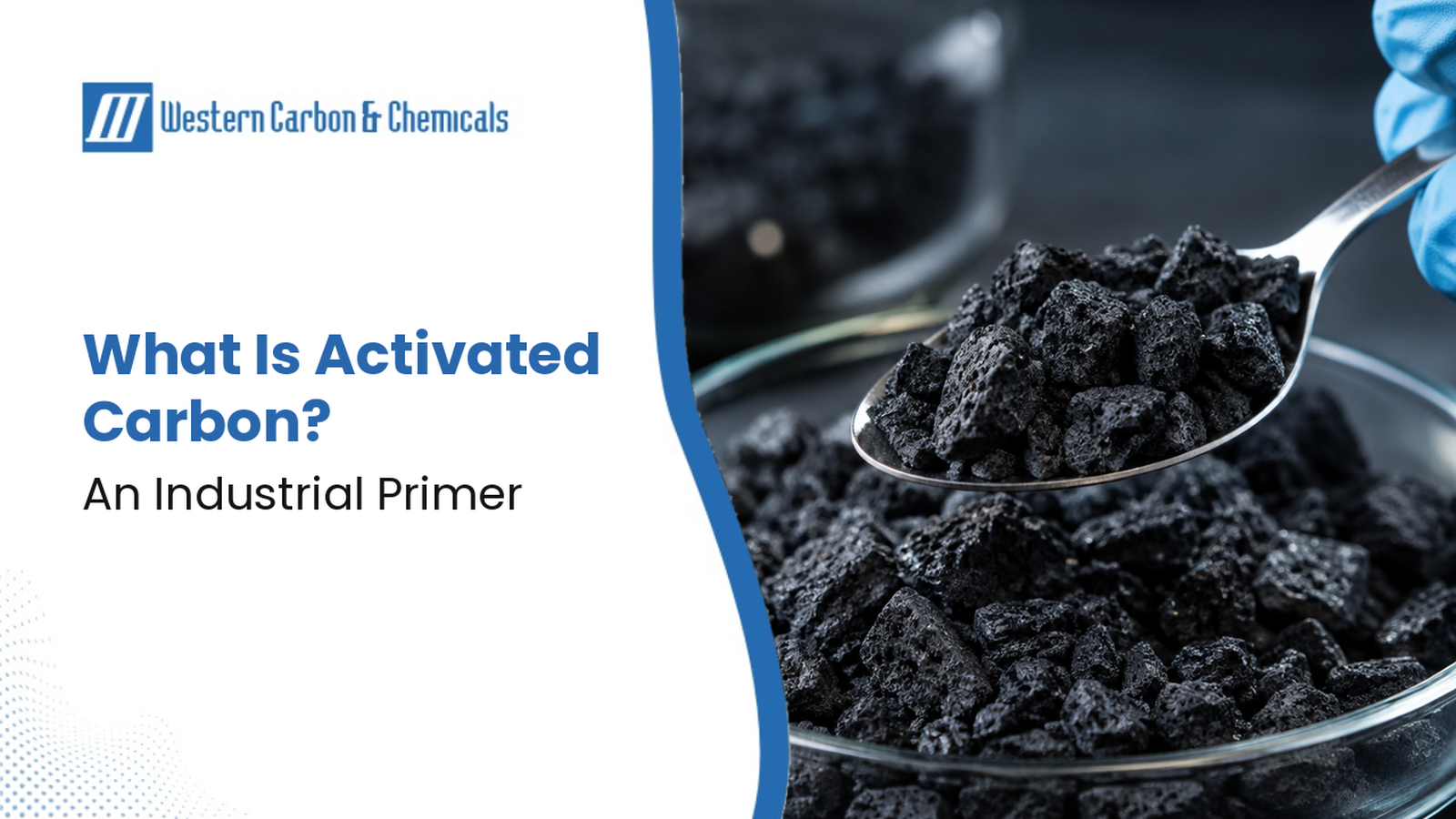
Activated carbon is a form of carbon that has been processed to have a very large internal surface area, typically from several hundred to more than a thousand square metres per gram. That surface is made of a network of tiny pores, and it is the pores, not the black solid itself, that give the material its purpose.
The material works by adsorption. Molecules in a liquid or gas are attracted to the pore surfaces and held there. Because the pore surface is so large, a small mass of carbon can hold a surprisingly large mass of contaminant. This is physical adsorption, so it is generally reversible, which is why carbon can in many cases be regenerated. Reversibility cuts both ways: a bed that is hot, wet or overloaded can release some of what it captured, so operating conditions matter as much as the carbon itself. It also explains why adsorption is strongest for large, non-polar molecules that dislike the water or air carrying them, and weakest for small, polar or highly soluble ones.
People often confuse activated carbon with ordinary charcoal. Charcoal is made by heating wood and has little developed pore structure. Activation is an additional step that opens and enlarges the pores. Our note on activated carbon versus activated charcoal covers the difference in detail.
2. Raw Materials: What Activated Carbon Is Made From
Almost any carbon-rich material can be turned into activated carbon, but only a few are used at industrial scale because they give good yield, consistent quality and the right pore structure. The raw material strongly influences the final product.
| Raw material | Typical character | Common uses |
|---|---|---|
| Coconut shell | Hard, micropore-rich, low ash | Drinking water, gold recovery, vapour-phase adsorption |
| Bituminous and sub-bituminous coal | Broad pore range, economical | Water and wastewater, industrial liquids and gases |
| Anthracite | Dense, low volatile | Specialised carbons and filtration media |
| Wood | Highly mesoporous, low density | Decolourisation of sugar, oils and chemicals |
| Peat and other biomass | Variable, often mesoporous | Specialty and food applications |
The background on these feedstocks is covered in raw materials of activated carbon, and the practical differences between the two most common ones are in coconut shell versus coal-based carbon.
For a buyer, the practical meaning of all this is that two products both sold as activated carbon can behave very differently. Raw material, activation method and particle form each shift pore structure, hardness and ash content, so a specification that names only the word carbon leaves too much open. A good specification lists the form, size range, key adsorption indicators and any cleanliness limits.
3. How Activated Carbon Is Made: Carbonisation and Activation
Manufacture involves two broad stages. First, the raw material is carbonised by heating in the absence of air, which drives off volatile matter and leaves a carbon-rich char. Second, the char is activated, which develops the pore structure.
Physical (thermal) activation
The char is exposed to steam or carbon dioxide at high temperature, typically in rotary kilns or multiple-hearth furnaces. The gases react selectively with carbon, burning out part of the structure and opening pores. Most coconut shell and coal-based granular carbon is made this way.
Chemical activation
The raw material is impregnated with a chemical such as phosphoric acid or zinc chloride and heated, which develops pores and typically gives a more mesoporous product. This route is common for wood-based carbons used in decolourisation.
Post-treatment
After activation, carbon may be acid washed to remove soluble minerals, impregnated with reactive chemicals for specific gases, crushed and sieved to a mesh size, or extruded into pellets. The relevant grades include acid-washed carbon and unwashed carbon.
4. Pore Structure: Micropores, Mesopores and Macropores
Pores are classified by width. Micropores are narrower than about two nanometres and provide most of the surface area. Mesopores are between two and fifty nanometres and act as transport channels, and are important for larger molecules. Macropores are wider than fifty nanometres and act as entrances.
A carbon rich in micropores suits small molecules such as chlorine, small solvents and gases. A carbon with more mesopores suits larger molecules, such as those causing colour in liquids. This is why “surface area” alone is not enough to describe a carbon, and why two carbons with the same iodine number can behave differently on the same stream.
Match pore size to molecule size. A molecule that cannot fit into a pore, or that is very small and weakly attracted, will not be adsorbed well regardless of the carbon’s total surface area.
5. Key Specifications and What They Mean
A carbon datasheet contains a short list of measurements. Understanding what each means lets you compare suppliers on a sensible basis, and avoid the common trap of comparing a single headline number such as iodine value while ignoring hardness, ash and particle size distribution. Two carbons with identical iodine numbers can differ in cost and in service life because one breaks down under backwash and the other does not.
| Specification | What it measures | Where it matters |
|---|---|---|
| Iodine number | Adsorption of iodine, an index of micropore area | General quality, water treatment, gold recovery |
| CTC activity or butane number | Capacity for organic vapours | Air, gas and solvent recovery duty |
| BET surface area | Total surface area by nitrogen adsorption | Research and comparison, with limits |
| Hardness or abrasion number | Resistance to attrition | Backwashed beds, gold recovery, regeneration |
| Ash content | Mineral impurities | Sensitive products, leaching concerns |
| Moisture | Water as supplied | True carbon mass bought |
| Particle size or mesh | Granule size distribution | Hydraulics and kinetics |
| Apparent density | Mass per volume | Vessel loading and bed volume |
| pH of extract | Acidity or alkalinity of the carbon | pH-sensitive products |
Iodine number and BET area are related but not interchangeable, as explained in iodine number versus BET surface area. Mesh designation is covered in granular carbon mesh size. Test methods are standardised by bodies such as ASTM and AWWA, and the American Water Works Association publishes standards for powdered and granular carbon used in water treatment.
Need help specifying activated carbon?
Tell us your application and Western Carbon will recommend the raw material, form, mesh and specification.
6. Forms of Activated Carbon
Activated carbon is supplied in several physical forms, each suited to different equipment.
Granular activated carbon (GAC)
Irregular granules in a mesh range, used in fixed beds for water and air. See granular activated carbon.
Powdered activated carbon (PAC)
Fine particles, usually below 0.18 millimetres, dosed directly into liquids and removed by settling or filtration. Common in taste and odour control and in food, pharma and chemical decolourisation. See powdered activated carbon.
Extruded carbon pellets
Cylindrical pellets made by extrusion, giving low pressure drop and high strength. Favoured for air and vapour-phase work. See extruded activated carbon pellets.
The full range of forms and where they fit is covered in forms of activated carbon.
7. Industrial Applications
The same adsorption principle supports many industries. In water treatment, carbon removes chlorine, taste, odour, colour and organic chemicals, as shown in activated carbon in water treatment. In air and gas treatment it captures solvents and odours, as covered in extruded carbon for air purification.
In mining, carbon adsorbs dissolved gold from cyanide solutions, and the process is described in activated carbon in gold recovery. In food, beverage and pharmaceutical production, carbon decolourises and purifies streams, as covered in powdered carbon in food and pharma. Other uses include solvent recovery, biogas cleanup, edible oil refining and chemical purification. For water contaminants specifically, the EPA drinking water treatability database records how well carbon removes individual compounds, which is a practical check before committing to a design. The point across all these industries is the same: carbon is chosen because it can be tuned, through raw material, activation and form, to the molecules that need to be removed.
Key point: no single carbon suits every application. Matching raw material, pore structure, form and specification to the duty is what separates a good purchase from an expensive disappointment.
8. How to Select and Specify Activated Carbon
A sensible selection process runs in a clear order. Define the substance to be removed and its concentration, and the medium it is in. Decide the process configuration, such as fixed bed or dosing. Choose a raw material and pore structure to suit the molecule, then a form and particle size to suit the hydraulics.
- State the contaminant, concentration and target outlet level.
- State the medium, flow, temperature and pH.
- Choose the raw material and activation type.
- Choose the form and mesh or pellet size.
- Specify minimum activity, hardness, maximum ash and moisture.
- Require a certificate of analysis for each batch.
For fixed-bed duty the sizing method is described in our guide to granular activated carbon filter design, and for powdered grades see choosing powdered activated carbon.
9. Quality, Handling, Safety and Regeneration
Quality depends on consistent raw material and process control, verified by batch testing. Ask for certificates and check them against the specification. Western Carbon’s certifications page outlines the quality systems behind its supply.
Handling and safety
Carbon dust is a nuisance and, in large amounts, can form combustible dust clouds, so dust control and ignition-source control apply. Wet activated carbon can deplete oxygen in enclosed spaces, which makes confined-space entry hazardous; follow lawful procedures and the guidance in the OSHA confined spaces resources. Carbon that has adsorbed reactive or flammable substances can self-heat, so storage and handling of spent carbon need care.
Regeneration and disposal
Spent carbon loaded with suitable organics can often be thermally reactivated and reused. Carbon loaded with hazardous or reactive materials may need to be disposed of as waste under applicable rules. The right route depends on what the carbon has captured. Where regeneration is planned, specify a hard carbon from the start, because reactivation involves repeated heating and handling, and a weak granule will lose mass and generate fines on each cycle.
General background on sources of air contaminants that carbon is used to control can be found in the US EPA indoor air quality resources, and on water contaminants in the WHO drinking water quality guidelines.
10. Who Uses Activated Carbon?
Activated carbon is used across a wide range of industries, and Western Carbon supplies media matched to each.
- Water utilities, industrial plants and wastewater operators.
- Mining and gold recovery operations.
- Food, beverage, pharmaceutical and chemical producers.
- Air purification, solvent recovery and gas treatment operators.
Branded lines such as WestGold, WestPharm and WestAqua map to specific applications, and the applications overview gives the full picture.
11. Related Reading
- Activated carbon is defined by its pore network, which is engineered through raw material and activation.
- Coconut shell, coal and wood give different pore structures and suit different molecules.
- Read specifications together: iodine, CTC or butane, hardness, ash, moisture and mesh.
- Granular, powdered and extruded forms fit different equipment and hydraulics.
- Match the carbon to the duty and ask for a batch certificate of analysis.
- Handle dust and wet carbon with care, and plan regeneration or disposal for spent carbon.
12. Frequently Asked Questions
What is activated carbon in simple terms?
Activated carbon is carbon processed to have an enormous network of tiny pores, giving it a very large internal surface. Contaminants in water or air stick to that surface by adsorption, which is why it is used to purify liquids and gases across many industries.
What is activated carbon made from?
Common raw materials are coconut shell, coal, wood and other biomass. Each gives a different pore structure, hardness and cost, so the raw material is a key part of choosing a carbon for a given job.
How is activated carbon activated?
Raw material is first carbonised by heating without air, then activated either physically with steam or carbon dioxide at high temperature, or chemically with agents such as phosphoric acid. Activation opens and enlarges the pores.
What does iodine number tell me?
Iodine number is a measure of adsorption of iodine and is used as an index of micropore surface area. It is a useful general quality figure, but it does not predict performance on every contaminant, so vapour activity or other tests may be needed.
What is the difference between GAC, PAC and extruded carbon?
GAC is granular carbon for fixed beds, PAC is fine powder dosed into liquids, and extruded carbon is cylindrical pellets with low pressure drop, favoured for air and vapour. The form is chosen to suit the equipment and process.
Can activated carbon be reused?
Often yes. Carbon loaded with suitable organics can be thermally reactivated and returned to service. Carbon that has captured hazardous or reactive materials may need disposal under applicable rules, so the route depends on what was adsorbed.
Is activated carbon safe to handle?
Generally, but dust control is needed and wet carbon can deplete oxygen in enclosed spaces, so confined-space precautions apply. Spent carbon that has adsorbed flammable or reactive materials can self-heat and needs careful storage.
What documents should I ask a carbon supplier for?
A certificate of analysis for each batch with iodine number or vapour activity, hardness, ash, moisture and mesh distribution, plus the carbon type and any treatment. Western Carbon provides batch documentation supported by its certifications.