 Summarize this Article with AI
- Mesh size describes the range of granule sizes in a carbon, using sieve numbers such as 8×30 or 12×40.
- A higher mesh number means smaller granules, faster adsorption, and higher pressure drop.
- Water treatment commonly uses 8×30 or 12×40, and vapour-phase work often uses 4×8 or similar coarser grades.
- Gold recovery typically uses coarse, hard carbon such as 6×12 so it can be screened away from the pulp.
- Uniformity and fines content matter as much as the nominal mesh range.
- The right mesh balances contact kinetics, hydraulics, backwash behaviour and the equipment you already have.
- What Does Mesh Size Mean?
- Common GAC Mesh Sizes at a Glance
- How Particle Size Affects Adsorption Kinetics
- Hydraulics: Pressure Drop, Bed Expansion and Backwash
- Mesh Selection for Water Treatment
- Mesh Selection for Air and Gas Treatment
- Mesh Selection for Mining, Food and Chemical Duty
- How to Choose the Right Mesh Size
- Quality Control, Testing and Documentation
- Who Specifies GAC Mesh Sizes?
- Related Reading
- Frequently Asked Questions
Specify granular activated carbon and the first question is usually mesh size. Buyers see numbers such as 8×30, 12×40 or 4×8 on a datasheet, and the distinction can feel arbitrary. It is not. Mesh size sets how quickly contaminants reach the carbon, how much pressure a bed loses, how well it backwashes and whether it can be separated from a slurry, so the wrong choice shows up as either poor removal or a bed that cannot pass the flow.
This guide explains what mesh numbers mean, how particle size changes performance, and which sizes suit which applications. It builds on our shorter explainer on granular carbon mesh size and goes further into selection by application and the practical trade-offs. Western Carbon supplies granular activated carbon in the common mesh ranges, and if you want broader context on the material first, see what activated carbon is.
1. What Does Mesh Size Mean?
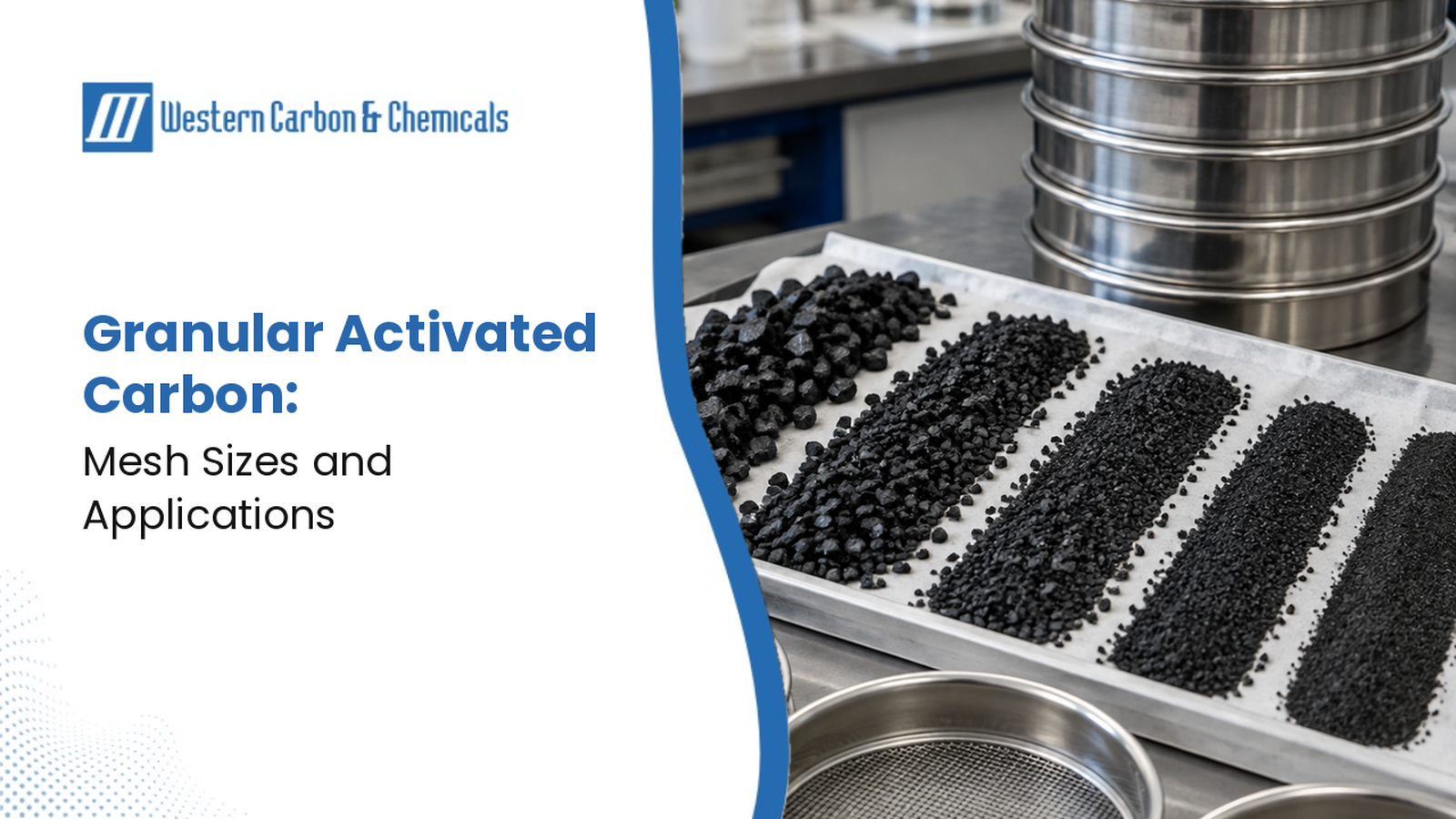
Mesh size comes from sieve analysis. A sieve is described by the number of openings per linear inch, so a higher number means smaller openings. A carbon specified as 12×40 passes through a number 12 sieve and is retained on a number 40 sieve. In other words, almost all granules fall between the two.
Using standard US sieve sizes, the openings correspond approximately to the following: number 4 is 4.75 millimetres, number 8 is 2.36, number 12 is 1.70, number 16 is 1.18, number 20 is 0.85, number 30 is 0.60, number 40 is 0.425 and number 50 is 0.30 millimetres. The mesh range therefore tells you the largest and smallest granules you should expect.
Mesh size is not the same as the pore size inside the carbon. Pores are measured in nanometres and decide which molecules can be adsorbed, while mesh describes the outer size of the granule. Particle size affects how fast molecules reach the pores, not which molecules fit. A useful picture is a sponge: the size of the pieces you cut it into does not change how much water the sponge material can hold, but smaller pieces fill and empty much faster. Mesh size works the same way, which is why it is a kinetic and hydraulic specification and not a capacity specification.
2. Common GAC Mesh Sizes at a Glance
| Mesh designation | Approximate size range | Typical applications |
|---|---|---|
| 4×8 | 4.75 to 2.36 mm | Vapour-phase, deep air beds, some industrial liquids |
| 6×12 | 3.35 to 1.70 mm | Gold recovery, coarse industrial use |
| 8×16 | 2.36 to 1.18 mm | Air and gas, water treatment |
| 8×30 | 2.36 to 0.60 mm | Municipal water, drinking water, general use |
| 12×30 | 1.70 to 0.60 mm | Water, food and beverage, general liquid phase |
| 12×40 | 1.70 to 0.425 mm | Drinking water, dechlorination, faster kinetics |
| 20×50 | 0.85 to 0.30 mm | Small cartridges, polishing, fast adsorption |
These are typical associations, and suppliers offer many variations. A narrower range, such as 12×30 compared with 8×30, gives a more uniform bed and more predictable hydraulics at a modest cost increase. Check the supplier’s datasheet for the actual size distribution. It is also worth confirming the effective size and uniformity coefficient where the supplier reports them, because these two numbers summarise the distribution better than the nominal range does and are what hydraulic calculations actually use.
Also Read: The Different Forms of Activated Carbon
One point worth stating plainly is that mesh size describes a range, not a single particle size. A grade labelled 8×30 contains grains that pass an 8 mesh screen and are retained by a 30 mesh screen, so a real sample includes a spread of sizes. The width of that spread, and the amount of fines and oversize allowed, are part of the specification and affect both flow and kinetics.
3. How Particle Size Affects Adsorption Kinetics
Adsorption is not instantaneous. A molecule must travel through the liquid film around the granule, then diffuse into the pore network before it can stick. Smaller granules have shorter internal diffusion paths and more external surface area for their volume, so molecules reach the active sites sooner.
The practical result is that a finer mesh achieves a given removal in a shorter bed, or a given bed performs better at higher flow. Where the contaminant adsorbs slowly, such as larger organic molecules or low-concentration targets, finer mesh makes a noticeable difference. Where the contaminant adsorbs fast, such as free chlorine, mesh matters much less. For slowly adsorbing compounds the difference can be large, because the rate-limiting step is diffusion inside the granule, and halving the granule diameter shortens that diffusion path considerably. This is the main reason polishing cartridges, which have very little bed depth to work with, tend to use fine grades such as 20×50.
If you need to shorten a carbon bed for the same removal, moving to a finer mesh is one lever. It costs you pressure drop, so check the hydraulics before you change.
4. Hydraulics: Pressure Drop, Bed Expansion and Backwash
Particle size also controls how the bed behaves hydraulically. Pressure drop across a packed bed rises sharply as particle size falls, so a finer carbon needs more pump head at the same flow. Finer carbon also fouls and blinds more easily when suspended solids are present.
Backwash and bed expansion
Backwash expansion depends on particle size and density. Finer, lighter granules expand more at a given backwash flow and are easier to lose from the vessel if free board is inadequate. Coarser granules need higher backwash flow to expand at all. Check the supplier’s expansion data for the grade and the water temperature, because cold water is denser and more viscous and expands the bed more.
Uniformity and fines
Two carbons with the same nominal mesh can behave differently if one has a wide size distribution. Fines fill the gaps between larger granules, raising pressure drop and encouraging channelling. Ask for the size distribution and the maximum fines content, not just the nominal range.
Key point: a uniform 12×30 can outperform a wide-range 8×30 in the same vessel, because uniformity gives predictable pressure drop and even flow. Nominal mesh is only part of the specification.
5. Mesh Selection for Water Treatment
Water treatment is the largest use of granular carbon. Municipal contactors commonly use carbon in the 8×30 or 12×40 ranges, balancing the kinetics needed to remove organics and taste and odour compounds against the hydraulics of deep, backwashable beds. Smaller point-of-entry and cartridge systems often use finer grades such as 12×40 or 20×50 to get good removal in a short bed.
For drinking water, hardness, low ash and low dust are additional concerns, which is why coconut shell carbon is popular, as discussed in coconut shell carbon for drinking water. The US EPA’s ground water and drinking water programme and its treatability database help match contaminants to carbon performance, and mesh is one parameter in that design.
If the bed must also filter particles, as in some filter-adsorber designs, a coarser grade and a multimedia arrangement using anthracite may be more suitable, as covered in why anthracite is used in water filtration.
Not sure which mesh size to specify?
Tell us flow, contaminant and equipment and Western Carbon will recommend a grade and size range.
6. Mesh Selection for Air and Gas Treatment
Air and gas treatment normally favours coarser carbon. The airflow through a bed is large, and the pressure available from fans is small, so low pressure drop matters. Grades such as 4×8 and 6×12, and 8×16 for deeper or finer duty, are common. Extruded pellets are often preferred where a very uniform bed and low pressure drop are needed, as described in extruded carbon for air purification.
In compact purifiers, a finer mesh such as 8×16 or 12×30 can give faster gas adsorption in a short bed, at the cost of airflow resistance. The designer has to match mesh to the fan curve. The US EPA indoor air quality resources provide context on the pollutants these systems address.
For the specification side, see our guide to carbon air filters for VOC and odour control.
When two mesh grades appear similar on paper, a small column test will usually settle the choice. Running both on the same water at the same flow, and comparing breakthrough time and pressure drop, shows directly which grade gives the better balance for that site. This is a cheap test relative to the cost of filling a large vessel with the wrong grade.
7. Mesh Selection for Mining, Food and Chemical Duty
Gold recovery
In carbon-in-pulp and carbon-in-leach circuits, carbon is mixed with the slurry and must be screened out afterwards. This calls for coarse, hard carbon, commonly around 6×12, that does not pass through the screens and resists attrition. See activated carbon in gold recovery and carbon in leach versus carbon in pulp.
Food, beverage and chemical purification
Fixed beds for decolourisation and purification commonly use mid-range granules such as 12×30 or 12×40, with attention to ash and leachables. Where the product is sensitive, acid-washed carbon is often chosen. When the process needs fast contact and the carbon can be filtered out afterwards, powdered carbon is used instead of granular.
8. How to Choose the Right Mesh Size
A sensible approach follows a short sequence.
- Start from the application and the flow: how much pressure is available?
- Decide how fast the target contaminant adsorbs, and whether a short bed is needed.
- Check the hydraulics: pressure drop, backwash expansion and free board.
- Consider fouling: are suspended solids present?
- Check the equipment: screens, underdrain slot size and nozzles must retain the chosen mesh.
- Ask for the size distribution, fines limit and hardness, not just the nominal range.
Underdrain nozzles and screens need openings smaller than the finest granule. Switching to a finer mesh without checking this can lead to carbon loss through the underdrain. If you are designing a new bed, our guide to GAC for water treatment shows how mesh fits into the wider design.
Mesh range and carbon quality are separate. A good mesh on a poor carbon, or the reverse, will not perform. Read mesh alongside iodine number or vapour activity, hardness and ash.
9. Quality Control, Testing and Documentation
Particle size is measured by sieve analysis, in which a weighed sample passes through a stack of standard sieves and the mass retained on each is recorded. Results are reported as the percentage within the nominal range, with limits on oversize and undersize.
Ask for a certificate of analysis for each batch showing size distribution along with activity, hardness, ash and moisture. Standards from the American Water Works Association describe test methods and requirements for granular carbon used in water treatment. Independent certification of products in drinking water contact, such as that described by NSF for drinking water treatment units, adds further assurance.
Western Carbon’s certifications page outlines the quality systems behind its supply, and the underlying measures of carbon quality are explained in iodine number versus BET surface area.
10. Who Specifies GAC Mesh Sizes?
Mesh selection is part of almost every GAC purchase, and Western Carbon supports each of these buyers.
- Water utilities and treatment plant designers.
- Water treatment dealers and cartridge manufacturers.
- Mining operators running gold recovery circuits.
- Industrial users in food, beverage, chemical and air treatment.
See also WestAqua for water treatment, WestGold for gold recovery, and the applications overview.
11. Related Reading
- Mesh describes granule size range, for example 12×40 means 1.70 to 0.425 millimetres.
- Finer mesh adsorbs faster but raises pressure drop, fouls sooner and expands more on backwash.
- Water treatment favours 8×30 or 12×40, air and gas favours coarser grades, gold recovery favours around 6×12.
- Uniformity and fines limits matter as much as the nominal range.
- Check underdrain slot size, screens and free board before changing mesh.
- Ask for size distribution on the certificate of analysis for every batch.
12. Frequently Asked Questions
What does 12×40 mesh mean for activated carbon?
It means the granules pass through a number 12 sieve and are retained on a number 40 sieve, so almost all are between about 1.70 and 0.425 millimetres. It is a fairly fine granular grade that gives fast adsorption and is widely used in drinking water and polishing.
Which GAC mesh size is best for water treatment?
Municipal and larger systems commonly use 8×30 or 12×40, balancing kinetics against pressure drop and backwash behaviour. Smaller cartridge or point-of-entry systems may use finer grades. The best choice depends on the contaminant, flow and hydraulic limits.
Does a smaller mesh remove more contaminants?
A finer mesh adsorbs faster, so it can achieve the same removal in a shorter bed or at higher flow. It does not change which molecules the carbon can adsorb, and it costs more pressure drop. Total capacity depends on the carbon, not the granule size.
Which mesh is used for gold recovery?
Coarse, hard carbon, commonly around 6×12, is used in carbon-in-pulp and carbon-in-leach circuits because it must be screened from the slurry and resist attrition. Hardness is as important as mesh in this duty.
What mesh size is used in air and vapour-phase carbon?
Coarser grades such as 4×8 and 6×12 are common because airflow resistance must be low, and 8×16 or finer is used in compact units that need faster adsorption. Extruded pellets are often chosen for uniform beds and low pressure drop.
What is the difference between mesh size and pore size?
Mesh size is the outer size of the granule, measured in millimetres through sieves. Pore size is the width of the internal channels, measured in nanometres, and decides which molecules can be adsorbed. Mesh affects how fast molecules reach the pores, not which fit.
Why does mesh size affect pressure drop?
Smaller granules leave smaller gaps between them, so water or air has a more tortuous path and loses more pressure. Pressure drop rises sharply as particle size falls, and fines in the bed raise it further.
Can I switch to a finer mesh without changing the vessel?
Only after checking pressure drop, backwash expansion, free board and the underdrain slot size. Finer carbon may pass through slots sized for a coarser grade, and it may expand more on backwash, so confirm with the supplier before changing.