 Summarize this Article with AI
- The correct HSN code for activated carbon in India is 3802 10 00 under the Customs Tariff Act, Chapter 38.
- Activated carbon attracts an 18% GST rate at both the domestic supply and import stages under IGST provisions.
- Export of activated carbon from India is freely permitted; no special licence is required under the Foreign Trade Policy.
- Key export documents include commercial invoice, packing list, bill of lading, certificate of analysis, MSDS, and a valid IEC code.
- The basic customs duty on imported activated carbon is 7.5%, making Indian-manufactured activated carbon cost-competitive for domestic buyers.
- Misclassifying activated carbon under HSN 2704 or other carbon-related codes is a common and costly compliance error.
- What Is the HSN Code for Activated Carbon?
- GST Rate on Activated Carbon in India
- HSN Code 3802 10 00: Activated Carbon Classification Explained
- Difference Between HSN 3802 and 2704 for Carbon Products
- Export Documentation Required for Activated Carbon
- IEC Code, RCMC and Export Registration for Activated Carbon
- Customs Duty and Import Requirements for Activated Carbon
- How to Classify Impregnated vs Standard Activated Carbon
- Common Errors in HSN Classification and How to Avoid Them
- Western Carbon Serves Customers Worldwide
- Related Reading
- Frequently Asked Questions
For procurement managers, finance teams, and logistics coordinators dealing with activated carbon in India, getting the HSN code and GST classification right is not optional. An incorrect code on a tax invoice or shipping bill can trigger GST scrutiny, customs delays, and penalties that far outweigh the product value. This article sets out the correct classification framework, applicable tax rates, and the full documentation chain required for both domestic supply and export of activated carbon.
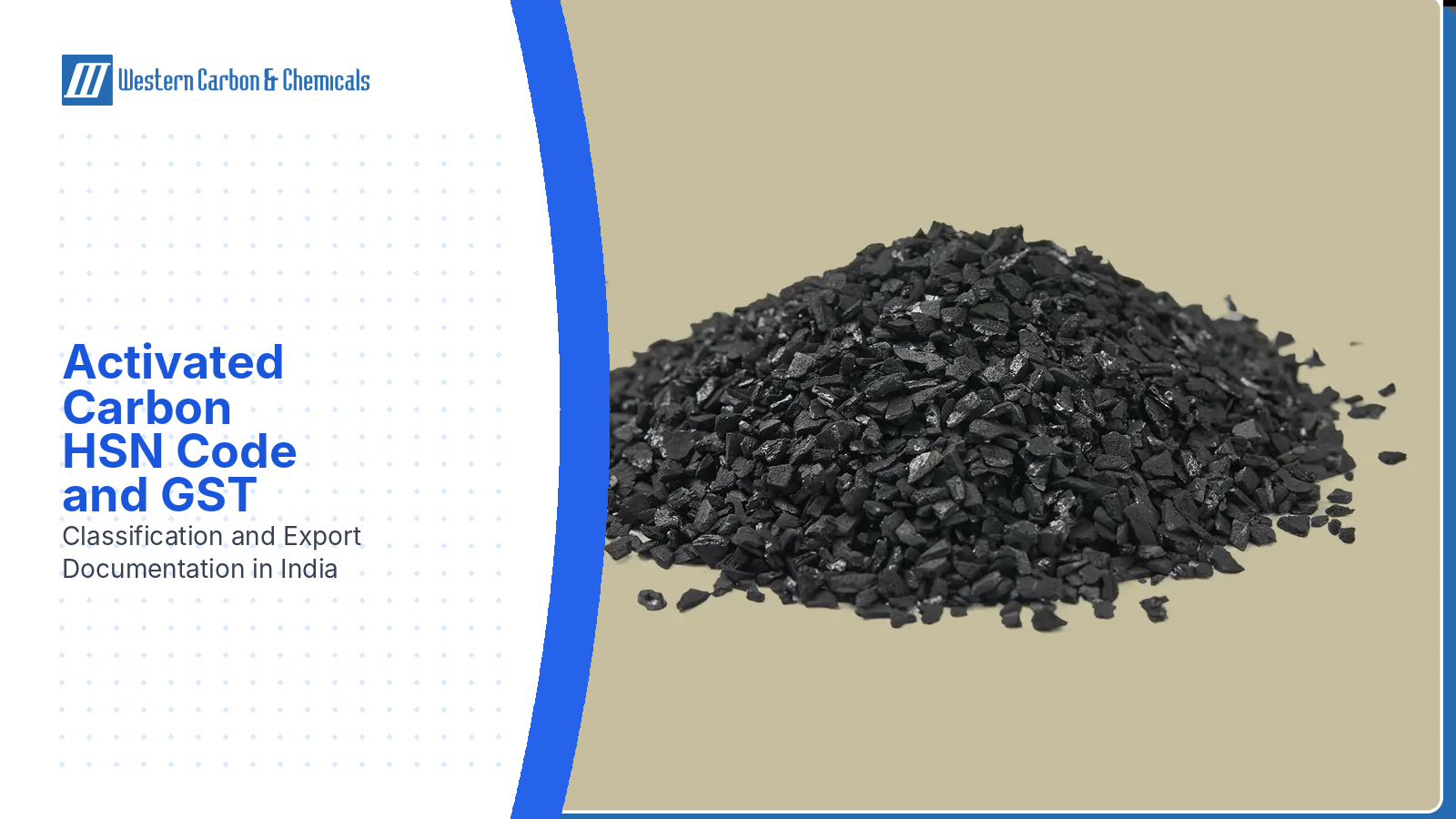
Activated carbon is a highly porous form of carbon used for adsorption in water treatment, air purification, food processing, pharmaceuticals, and industrial applications. Western Carbon and Chemicals, one of India’s leading activated carbon suppliers, handles documentation for domestic and export customers across all product categories including granular activated carbon, powdered activated carbon, and extruded pellets.
1. What Is the HSN Code for Activated Carbon?
The Harmonised System of Nomenclature (HSN) code for activated carbon in India is 3802 10 00. This classification is defined under Schedule I of the Customs Tariff Act, 1975, and mirrors the international Harmonised System maintained by the World Customs Organization (WCO).
The HSN hierarchy for activated carbon breaks down as follows:
| HSN Level | Code | Description |
|---|---|---|
| Chapter | 38 | Miscellaneous chemical products |
| Heading | 3802 | Activated carbon; activated natural mineral products; animal black |
| Sub-heading | 3802 10 | Activated carbon |
| Tariff item | 3802 10 00 | Activated carbon (all forms) |
This eight-digit code is used on all tax invoices for GST purposes, on shipping bills for exports, and on bills of entry for imports. The code is the same regardless of whether the activated carbon is coal-based, wood-based, coconut shell-based, or manufactured by any other raw material route.
The HSN code 3802 10 00 applies to all physical forms of activated carbon: granular, powdered, extruded pellets, acid-washed, and impregnated varieties. The form does not change the classification at the eight-digit level in the Indian customs tariff.
2. GST Rate on Activated Carbon in India
Activated carbon classified under HSN 3802 10 00 attracts a GST rate of 18%. This rate applies uniformly to intra-state supply (CGST 9% + SGST 9%) and inter-state supply (IGST 18%). The classification was confirmed under Schedule III of Notification No. 1/2017-Central Tax (Rate) dated 28 June 2017 and has not been revised in subsequent GST Council meetings.
| Supply Type | Tax Component | Rate |
|---|---|---|
| Intra-state (within same state) | CGST + SGST | 9% + 9% = 18% |
| Inter-state (between states) | IGST | 18% |
| Import (into India) | IGST on assessable value + customs duties | 18% |
| Export (out of India) | Zero-rated supply under IGST Act | 0% (with LUT or refund) |
Exporters have two options for handling GST on export supplies. They can export under a Letter of Undertaking (LUT) without payment of IGST, or they can pay IGST at 18% and claim a refund from the GST department after export. Most exporters prefer the LUT route as it avoids working capital blockage. Western Carbon supports customers with correct GST documentation for all supply types.
3. HSN Code 3802 10 00: Activated Carbon Classification Explained
Chapter 38 of the Customs Tariff Act covers a broad range of chemical products that do not fit neatly into more specific chemical chapters. Heading 3802 specifically covers activated carbon and activated natural mineral products. The critical word is “activated” – the activation process, whether by steam, carbon dioxide, or chemical means, transforms raw carbonaceous materials into the highly porous adsorbent that justifies classification under this heading rather than under coal, coke, or basic chemical headings.
The Central Board of Indirect Taxes and Customs (CBIC) has clarified through various advance rulings that the determining factor for 3802 classification is the activation treatment and the resulting adsorption capability. The raw material origin (coal, coconut shell, wood, peat) is irrelevant to the classification at the HSN level.
Forms of Activated Carbon Under 3802 10 00
All of the following product types sold by Western Carbon fall under HSN 3802 10 00:
- Granular activated carbon (GAC) – 8×30, 12×40, 20×50 mesh and other sizes
- Powdered activated carbon (PAC) – below 100 mesh
- Extruded activated carbon pellets – 1.5mm, 3mm, 4mm diameters
- Acid-washed activated carbon
- Unwashed activated carbon
Regulatory note: The Ministry of Finance and CBIC have confirmed through Advance Ruling AAR-GST/15/2021 and similar rulings that activated carbon in all forms – regardless of raw material or post-processing – is classified under HSN 3802 10 00 and taxed at 18% GST. Source: CBIC Advance Ruling Database.
4. Difference Between HSN 3802 and 2704 for Carbon Products
One of the most common classification errors involves confusing activated carbon with coke or charcoal. The difference in tax treatment can be significant, and customs officers routinely scrutinise shipments that appear to be carbon products.
| HSN Code | Product Description | GST Rate | Key Characteristic |
|---|---|---|---|
| 3802 10 00 | Activated carbon | 18% | Activated by steam, CO2, or chemicals; high surface area; adsorbent |
| 2704 00 10 | Coke and semi-coke of coal | 5% | Solid carbon residue from coal distillation; not activated; used as fuel or reducing agent |
| 4402 | Wood charcoal (including shell or nut charcoal) | 5% | Charred wood or shells; not activated; not an adsorbent product |
| 3802 90 00 | Activated natural mineral products; animal black | 18% | Non-carbon activated mineral adsorbents; animal charcoal (bone black) |
The critical distinction between HSN 3802 and HSN 2704 or 4402 is the activation treatment. Coconut shell charcoal that has not been activated is classified under 4402. The same coconut shell charcoal, once subjected to steam activation or chemical activation to develop its pore structure and surface area, becomes activated carbon and must be classified under 3802 10 00.
5. Export Documentation Required for Activated Carbon
Exporting activated carbon from India requires a standard set of shipping and trade documents. Western Carbon prepares all documentation in-house for its export customers, ensuring clean customs clearance at both the Indian origin port and the destination country.
| Document | Purpose | Issued By |
|---|---|---|
| Commercial Invoice | Primary trade document; value declaration for customs | Exporter (Western Carbon) |
| Packing List | Details of packages, weights, dimensions | Exporter |
| Bill of Lading / Airway Bill | Contract of carriage; title document for sea/air freight | Shipping line or airline |
| Certificate of Origin (COO) | Declares Indian origin; required for preferential duty under trade agreements | Export Inspection Council (EIC) or authorised body |
| Shipping Bill | Customs export declaration filed with Indian Customs via ICEGATE | Exporter / CHA |
| Certificate of Analysis (COA) | Technical specifications: iodine number, ash content, moisture, mesh size | Exporter / Third-party lab |
| Material Safety Data Sheet (MSDS) | Safety classification; required for all chemical shipments | Exporter |
| Letter of Undertaking (LUT) | Allows export without payment of IGST (zero-rated) | Filed by exporter on GST portal |
For shipments to countries with which India has a Free Trade Agreement (FTA), such as ASEAN member states, UAE (CEPA), or Australia (ECTA), a preferential Certificate of Origin may allow the buyer to claim reduced import duties in their country. The applicable form varies by agreement (Form AI for ASEAN, Form I for UAE CEPA, etc.).
Export-Ready Activated Carbon from Western Carbon
All shipments come with complete export documentation including COA, MSDS, and customs declarations. We supply to 50+ countries with clean customs clearance at every port.
6. IEC Code, RCMC and Export Registration for Activated Carbon
Before exporting activated carbon from India, an exporter must hold a valid Importer Exporter Code (IEC). This is a 10-digit alphanumeric code issued by the Directorate General of Foreign Trade (DGFT) and is a mandatory prerequisite for filing shipping bills and receiving export benefits.
How to Obtain an IEC
IEC registration is now a fully online process through the DGFT portal (dgft.gov.in). The application requires PAN, GST registration, a cancelled cheque, and basic business registration documents. DGFT typically issues the IEC within 2-3 working days of a complete application.
RCMC for Export Benefits
An RCMC (Registration Cum Membership Certificate) from the relevant Export Promotion Council (EPC) is required to claim benefits under the Foreign Trade Policy, including duty drawback, Remission of Duties and Taxes on Exported Products (RoDTEP), and other incentives. For activated carbon exporters, the relevant EPC is typically Chemexcil (Basic Chemicals, Pharmaceuticals and Cosmetics Export Promotion Council) or the Chemicals and Allied Products Export Promotion Council (CAPEXIL).
Activated carbon exporters should verify their RoDTEP rate under the applicable Schedule. As of the latest Foreign Trade Policy 2023 schedule, activated carbon (3802 10 00) attracts a RoDTEP rebate rate that partially offsets input taxes embedded in the export price. Check the DGFT notification for the current rate applicable to your product.
7. Customs Duty and Import Requirements for Activated Carbon
India imposes a layered customs duty structure on imported activated carbon. Understanding the total duty burden is essential for procurement teams evaluating imported versus domestically manufactured activated carbon.
| Duty Component | Rate | Notes |
|---|---|---|
| Basic Customs Duty (BCD) | 7.5% | Applied on CIF value |
| Social Welfare Surcharge (SWS) | 10% of BCD | 0.75% effective on CIF |
| Agriculture Infrastructure and Development Cess (AIDC) | Varies | Check current notification for activated carbon |
| IGST on import | 18% | Applied on CIF + BCD + SWS |
The effective total duty on imported activated carbon is approximately 28-30% of the CIF value, making Indian-manufactured activated carbon from suppliers like Western Carbon significantly more cost-competitive for domestic buyers. IGST paid on import is fully creditable as input tax credit (ITC) for GST-registered purchasers, so the effective cost of import duty for a registered buyer is the BCD and SWS component only.
Importers must file a Bill of Entry on ICEGATE (Indian Customs Electronic Data Interchange Gateway) through a Customs House Agent (CHA) and obtain examination and clearance before taking delivery of the goods. For acid-washed activated carbon or specialty grades, buyers may need to submit a COA to satisfy customs examination requirements.
8. How to Classify Impregnated vs Standard Activated Carbon
Impregnated activated carbon is a specialised product category where the carbon has been treated with specific chemical agents to enhance its performance for particular gas-phase applications. Western Carbon manufactures several impregnated grades under its WestDiox and WestFiltra brands.
Classification Principles for Impregnated Activated Carbon
The general rule under the Harmonised System is that impregnated activated carbon remains classified under 3802 10 00 as long as the product’s essential character is that of an activated carbon adsorbent. The impregnant (sulphur, potassium iodide, copper, sodium hydroxide) is a minor component added to modify the carbon’s affinity for specific gases; it does not transform the product into a chemical compound or a different category of goods.
CBIC advance rulings in analogous product categories have consistently held that the classification follows the base product when the additive does not change the fundamental nature of the goods. Importers of impregnated activated carbon should, however, obtain a binding tariff ruling from the customs authority at the port of import if the impregnant concentration is high or if customs officers raise classification queries.
Documentation for Impregnated Carbon
For impregnated activated carbon, the COA and MSDS should clearly state the nature and concentration of the impregnant. Shipping documents should describe the product as, for example, “Activated Carbon, Sulphur Impregnated, HSN 3802 10 00.” A vague description such as “carbon product” is an open invitation for customs examination and potential reclassification.
9. Common Errors in HSN Classification and How to Avoid Them
Classification errors in activated carbon shipments are more common than many exporters and importers realise. The following errors carry the risk of GST demand notices, customs penalties, and shipment delays.
Error 1: Using 2704 Instead of 3802
Some suppliers incorrectly use HSN 2704 (coke and semi-coke) for activated carbon, possibly because both are carbon-based products derived from coal or similar raw materials. HSN 2704 attracts only 5% GST compared to 18% under 3802, making this error both a legal risk and an apparent short-term saving that can result in tax demand with interest and penalties.
Error 2: Using 4402 for Coconut Shell Activated Carbon
Coconut shell charcoal (unactivated) is correctly classified under 4402. Once activated, it must move to 3802 10 00. Suppliers using 4402 for activated coconut shell carbon are using an incorrect code that understates GST by 13 percentage points.
Error 3: Applying a 6-Digit HSN on Invoices Above the Threshold
Under GST rules, businesses with annual turnover above Rs. 5 crore must use the full 8-digit HSN code on tax invoices. Using only 4 or 6 digits is a compliance failure that can attract a penalty of Rs. 50,000 per invoice under Section 125 of the CGST Act.
Error 4: Incorrect Description on Shipping Bills
A shipping bill that describes the goods as “charcoal” or “carbon granules” rather than “activated carbon” can trigger customs examination, re-testing, and potential reclassification. The description must match the HSN code and the COA.
Always cross-check your HSN classification against the CBIC Customs Tariff and confirm with your Customs House Agent before filing a shipping bill. For advance certainty, file for a Binding Advance Ruling from the Authority for Advance Rulings (AAR) under Section 28H of the Customs Act, 1962. Source: CBIC.gov.in.
10. Western Carbon Serves Customers Worldwide
Western Carbon and Chemicals exports activated carbon from India to customers across Asia, the Middle East, Europe, Africa, and the Americas. Our export team handles all documentation including shipping bills, COA, MSDS, certificates of origin, and preferential duty certificates under applicable FTAs.
11. Related Reading
12. Frequently Asked Questions
What is the HSN code for activated carbon in India?
The correct HSN code for activated carbon in India is 3802 10 00. This falls under Chapter 38 of the Customs Tariff Act, which covers miscellaneous chemical products. The code applies to all forms of activated carbon regardless of raw material (coal, coconut shell, wood) or physical form (granular, powdered, pellet).
What is the GST rate on activated carbon?
Activated carbon attracts an 18% GST rate in India under HSN code 3802 10 00. This applies to all forms including granular activated carbon, powdered activated carbon, and extruded pellets. The 18% rate is split as CGST 9% + SGST 9% for intra-state supply, or IGST 18% for inter-state supply.
Is activated carbon export from India permitted?
Yes, activated carbon export from India is freely permitted under the Foreign Trade Policy 2023. No special licence or permission is required. Exporters need a valid IEC (Importer Exporter Code) issued by DGFT, and must file a shipping bill on ICEGATE. Zero-rated export status means GST is not payable on export supplies when an LUT has been filed.
What documents are required to export activated carbon from India?
Required documents include a commercial invoice, packing list, bill of lading or airway bill, certificate of origin, shipping bill filed on ICEGATE, certificate of analysis (COA) showing iodine number, ash content and mesh size, MSDS, and a valid IEC number. Exporters claiming duty drawback or RoDTEP benefits also require an RCMC from Chemexcil or CAPEXIL.
What is the difference between HSN 3802 and HSN 2704?
HSN 3802 covers activated carbon and activated natural mineral products used for adsorption purposes. The activation process is the defining characteristic. HSN 2704 covers coke, semi-coke, and retort carbon derived from coal or lignite, which is not activated and is used primarily as fuel or in metallurgical processes. Activated carbon must always be classified under 3802, not 2704, regardless of its coal raw material origin.
What is the import duty on activated carbon in India?
The basic customs duty (BCD) on imported activated carbon (HSN 3802 10 00) is 7.5% of CIF value. Additional levies include social welfare surcharge at 10% of BCD (effectively 0.75% on CIF) and IGST at 18% on the total assessable value. The total effective duty is approximately 28-30%. IGST paid on import is fully creditable as input tax credit for GST-registered importers.
How is impregnated activated carbon classified under HSN?
Impregnated activated carbon (impregnated with sulphur, potassium iodide, copper, or alkali) is classified under HSN 3802 10 00 along with standard activated carbon. The impregnant is a minor additive that modifies performance without changing the essential character of the product. The COA and shipping description should state the product as “Activated Carbon, [Impregnant] Impregnated” with the HSN code 3802 10 00 clearly cited.
Does activated carbon require a BIS certification for export?
BIS certification is not mandatory for all activated carbon exports from India. However, customers in regulated sectors such as pharmaceuticals, food processing, or municipal water treatment may request IS 877 (Indian Standard for activated carbon) compliance as part of their procurement specification. Western Carbon maintains relevant quality certifications for supply to these sectors. See our certifications page for details.