 Summarize this Article with AI
- Carbon in aquatic systems removes chlorine, chloramine, dissolved organics, colour, odour and some medications.
- It does not remove ammonia or nitrite, which are handled by biological filtration.
- In recirculating aquaculture it polishes water and removes ozone and oxidant residuals before they reach fish.
- Low-phosphate, low-ash, acid-washed coconut shell carbon is usually preferred to avoid leaching.
- Carbon must be removed during medication, since it adsorbs the treatment as well as the contaminants.
- Carbon loses effectiveness over time and needs planned replacement to avoid releasing what it captured.
- Why Aquatic Systems Use Activated Carbon
- What Carbon Removes in Aquatic Systems
- What Carbon Does Not Remove
- Aquarium Use: Canisters, Bags and Inline Filters
- Recirculating Aquaculture Systems (RAS) and Hatcheries
- Choosing the Right Carbon for Aquatic Use
- Sizing, Contact Time and Placement
- Maintenance, Replacement and Risks
- Common Mistakes and How to Avoid Them
- Who Uses Carbon in Aquatic Systems?
- Related Reading
- Frequently Asked Questions
Fish are far more sensitive to water quality than people are. A trace of chlorine that no one would taste in a glass of water can kill fish within minutes, and slow build-up of dissolved organics can stress animals long before water looks dirty. Activated carbon is one of the oldest and most useful tools for managing these problems, in home aquariums and in commercial aquaculture alike.
This guide explains what activated carbon does in aquatic systems, what it does not do, how it is used in aquariums and in recirculating aquaculture systems, and how to choose and manage the carbon. Western Carbon supplies granular activated carbon and other forms, and our general explanation of what activated carbon is is a good background read.
1. Why Aquatic Systems Use Activated Carbon
Aquatic animals live in the water they are treated for, so contaminants that would be minor for human use can be acutely harmful. Fish gills expose blood to the water across a large surface area, which makes them vulnerable to chlorine, chloramine and dissolved toxins. Organics released by feed and waste accumulate, colour the water, cause odours and can foster disease.
Carbon removes many of these through adsorption. It can be used on incoming make-up water, on water leaving a treatment step, or as a continuous side-stream polishing stage. It is a chemical filter, not a biological one, and it complements the biological and mechanical filtration that every aquatic system also needs.
The FAO aquaculture resources and the NOAA aquaculture programme describe the scale and diversity of the sector, from small hatcheries to large recirculating farms, and water quality is a recurring theme in both.
2. What Carbon Removes in Aquatic Systems
Chlorine and chloramine
Municipal water used for fills and top-ups contains chlorine or chloramine, both toxic to fish. Carbon removes free chlorine quickly. Chloramine takes longer, and catalytic carbon is often used for it, as described in activated carbon in water treatment. The EPA explanation of chloramines notes that fish owners and aquaculture operators need to remove it from tap water.
Dissolved organics and colour
Feed residues, fish excretions and decaying material release dissolved organic compounds that yellow the water and consume oxygen. Carbon adsorbs many of these, clarifying the water and reducing the load on biological filters. This is particularly useful in closed systems, where organics accumulate.
Odour and off-flavour compounds
Some compounds produced by algae and bacteria, such as geosmin, give farmed fish an earthy off-flavour that reduces market value. Carbon can adsorb them from water, which is one reason it is used in depuration and in recirculating systems.
Ozone and oxidant residuals
Many recirculating farms use ozone to oxidise organics and control microbes. Residual ozone and its by-products are harmful to fish, so water is passed over activated carbon to destroy the residual before it returns to the tanks.
Carbon is often most valuable at the point where treated water re-enters the fish tanks, as a final guard against oxidant residuals.
Good practice starts with a clear water balance. Before choosing a carbon, the operator should list every source of organic load, including feed, fish waste, uneaten food and any treatment chemicals, and note which of these the carbon stage is actually expected to handle. Without that list it is easy to oversize one stage and neglect another, and the carbon bed becomes an expensive way to hide a feeding or stocking problem.
3. What Carbon Does Not Remove
Understanding the limits prevents costly mistakes. Carbon does not remove ammonia or nitrite in any useful way. These are the main toxic wastes in fish systems and are handled by biological filtration, where bacteria convert ammonia to nitrite and then to nitrate. It does not remove nitrate or dissolved salts either, and it does not disinfect.
The EPA aquatic life criteria for ammonia explain why ammonia control matters for aquatic life, and show why a carbon filter is no substitute for adequate biological filtration and water exchange.
Key point: carbon polishes water, it does not replace biological filtration. Chloramine reduction on carbon even releases some ammonia, so a chloramine-treated fill needs ammonia control as well.
Carbon also removes trace elements and, in some cases, beneficial substances, so it is not suitable for every tank at every moment. Operators of planted aquariums, for example, may limit its use for this reason.
4. Aquarium Use: Canisters, Bags and Inline Filters
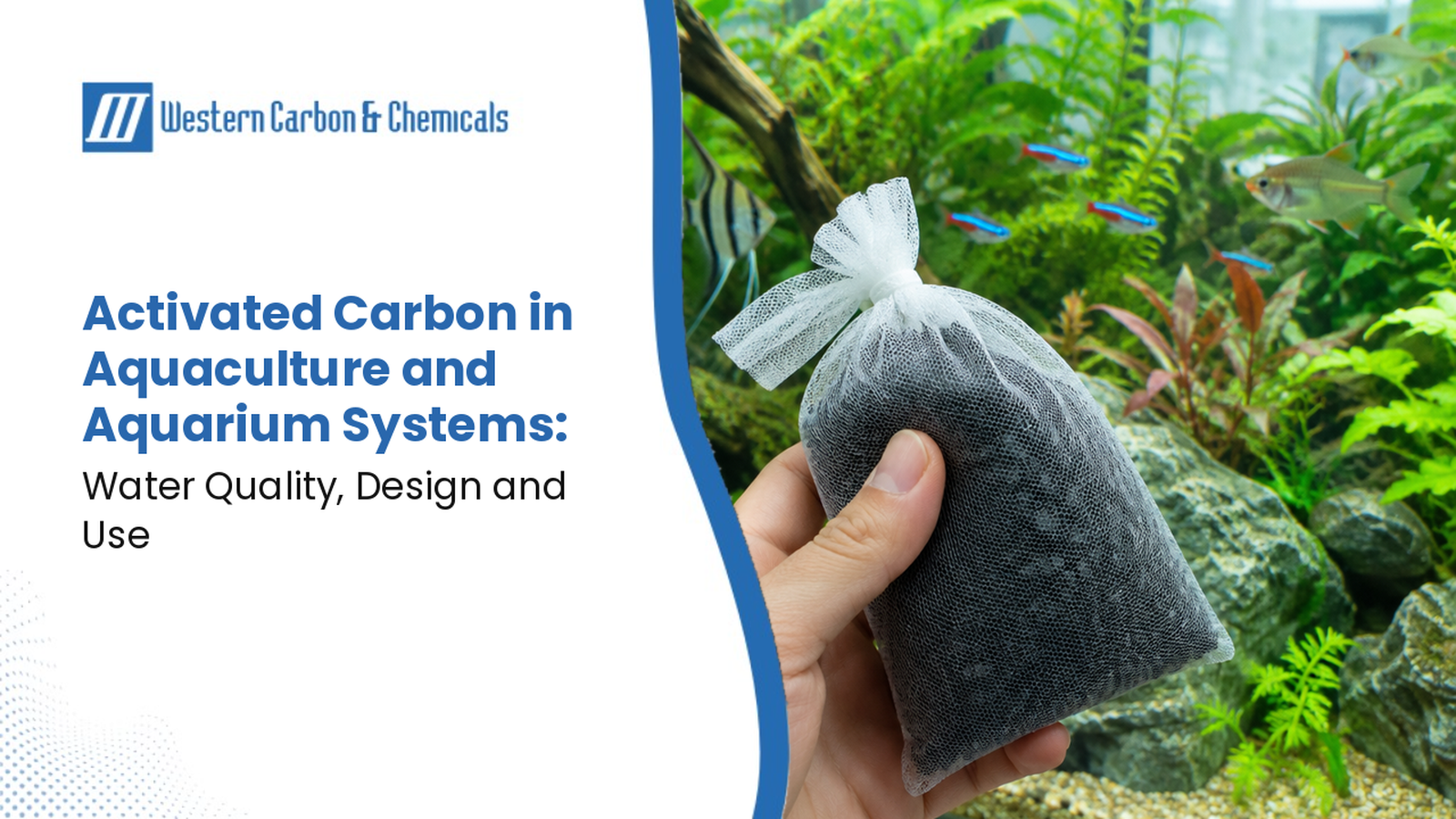
In aquariums, carbon is typically placed in a filter canister, a mesh bag in a hang-on-back filter or a cartridge. Water flows through the carbon, and contaminants adsorb. Granular carbon suits bags and canisters, and extruded pellets give low flow resistance and are less dusty.
- Rinse new carbon thoroughly to remove dust before use.
- Place the carbon where water flows through it, not around it.
- Replace carbon regularly, because it saturates, and saturated carbon can release what it held.
- Follow the carbon maker’s guidance on quantity for the tank volume.
- Remove carbon while treating with medications, and replace it afterwards.
The need to remove carbon during medication is important. Carbon adsorbs many medications and would reduce the dose to ineffective levels. After treatment, fresh carbon can be used to remove the residue.
Contact time and bed depth matter as much in a fish system as in an industrial one. A shallow bed with high flow gives the water little chance to equilibrate with the carbon, so removal falls and breakthrough comes early. Designers who size on empty bed contact time rather than on flow alone find it far easier to compare candidate carbons and to predict how long a fill will last before it needs replacing.
5. Recirculating Aquaculture Systems (RAS) and Hatcheries
In commercial recirculating systems, water is treated continuously: solids are removed, biofilters convert ammonia and nitrite, gases are managed and the water is returned to the tanks. Carbon is used as a polishing stage on a side-stream, at make-up water treatment and downstream of ozone.
Hatcheries are particularly sensitive, since eggs and larvae are fragile, and often use carbon on all incoming water to remove chlorine, organics and contaminants. Designers apply fixed-bed carbon design principles, covered in standard fixed-bed carbon design guidance and sized by contact time, and the system often includes a backwashable bed.
| Location in system | Purpose of carbon | Typical form |
|---|---|---|
| Make-up water inlet | Remove chlorine and chloramine | GAC bed or catalytic carbon |
| Side-stream polishing | Remove dissolved organics, colour, odour | GAC bed |
| After ozone treatment | Destroy ozone residual | GAC bed with adequate contact time |
| Depuration or pre-harvest | Reduce off-flavour compounds | GAC bed |
| Household aquarium | Chlorine, organics, colour | Granular or pelletised carbon in canister or bag |
Need carbon for an aquatic system?
Tell us the system, water source and targets and Western Carbon will recommend a low-leach carbon grade and format.
6. Choosing the Right Carbon for Aquatic Use
Quality matters more in aquatic systems than in many industrial uses, because leachables go straight into the animals’ water. Poor carbon can release phosphate, which feeds algae, and metals, which can be toxic. Look for low-ash carbon, ideally acid-washed carbon, with low phosphate and low heavy metal content.
Coconut shell carbon is a common choice because it is hard, micropore-rich and low in dust and ash, as explained in coconut shell versus coal-based carbon. Unwashed grades are suitable for industrial uses but are generally not preferred for aquatic systems where leaching is a concern.
Ask the supplier for ash, phosphate and metal data and a certificate of analysis. Independent certification of products in contact with water, such as that described by NSF drinking water treatment unit standards, offers additional assurance where relevant.
Pre-rinsing is a step that is often skipped and should not be. New carbon contains fine dust that clouds water and can irritate gills, and some grades release a small amount of ash or soluble material at first. Rinsing the fresh carbon in clean water until the run-off is clear protects the animals and keeps the downstream mechanical filter from loading up with fines on its first day.
7. Sizing, Contact Time and Placement
In larger systems, carbon beds are sized by empty bed contact time and flow, as with any filter. Free chlorine needs a short contact time, chloramine needs more, and dissolved organics need a contact time based on the load and the target. Ozone destruction on carbon is fast, but the bed must be sized for the residual and for how long it will run.
Because a recirculating system passes the same water repeatedly, side-stream flow can be a fraction of the total circulation. Treating a portion of the flow continuously keeps organics down without sizing the bed for the full flow. Particle size and mesh affect hydraulics and kinetics, as explained in granular carbon mesh size.
Put a particle filter ahead of the carbon. Fish solids block carbon quickly, and a bed that is also a solids trap becomes a biological hotspot.
8. Maintenance, Replacement and Risks
Carbon saturates, and it does so without any visible sign. Once saturated, it stops removing contaminants, and in some conditions can release some of what it captured. Plan replacement by schedule or by measurement, and do not leave exhausted carbon in the system.
Beds can also become biologically active. Carbon surfaces host bacteria that consume organics, which can be beneficial but can also cause problems if the bed becomes anoxic. Backwash and flow management help. Dust is another concern in new carbon, hence the advice to rinse it.
Test the water for the contaminants of concern, for example chlorine or organic load, after the carbon stage, so you know it is working. For general water-handling hygiene, guidance such as the CDC healthy water resources is a helpful reference. Our guide to when to replace an activated carbon filter provides practical triggers.
Monitoring turns carbon from guesswork into a managed consumable. A simple routine of testing the bed outlet for the contaminant of concern, logging the result against the date and the volume treated, and replacing the carbon at a set fraction of the measured breakthrough point gives a replacement interval grounded in data. Operators who keep these records often discover that the real service life is quite different from the supplier’s rough estimate.
9. Common Mistakes and How to Avoid Them
Most carbon problems in aquatic systems come from a small set of avoidable errors. Using carbon to solve a problem it cannot solve, such as treating a biological imbalance with chemical filtration, wastes money and delays the real fix. Understanding what carbon does, and what it does not, prevents most disappointments.
Errors that cost animals and money
- Skipping the rinse so that dust reaches gills and clouds the water.
- Leaving exhausted carbon in the system, where it can release some of what it adsorbed.
- Choosing a grade with high ash or soluble content for sensitive species.
- Running carbon on water that still carries chlorine when a dechlorination step was planned.
- Replacing carbon on a fixed schedule without any water testing.
If a medication is being dosed, remove carbon from the circuit for the treatment period, since it can adsorb the medicine and reduce its effect.
A practical routine pairs a regular water test with a recorded replacement date, so that each change is based on evidence. Over several cycles this builds a reliable picture of how fast the carbon is consumed in that particular system, which is the most useful number for planning and budgeting.
10. Who Uses Carbon in Aquatic Systems?
Carbon is used by a range of operators in aquatic systems, and Western Carbon supplies each.
- Home aquarium keepers and aquarium retailers.
- Hatcheries and recirculating aquaculture farms.
- Public aquariums, research facilities and ornamental fish breeders.
- Seafood processors and depuration facilities.
Water-focused lines such as WestAqua and the applications overview show the wider uses of carbon.
Disposal and handling close the loop. Spent carbon that has adsorbed only organics from clean make-up water is generally handled as ordinary solid waste, but this depends on local rules and on what the water carried. Operators should confirm the requirements with the relevant authority, and should never assume that a bed used on a medicated or chemically dosed system can be discarded without thought.
11. Related Reading
- Carbon removes chlorine, chloramine, dissolved organics, colour, odour and ozone residuals in aquatic systems.
- It does not remove ammonia or nitrite, so it cannot replace biological filtration.
- Choose low-ash, low-phosphate, acid-washed carbon to avoid leaching into the animals’ water.
- Remove carbon during medication, since it adsorbs the treatment as well.
- Replace carbon on schedule, because saturated carbon gives no visible warning.
- Put particle filtration ahead of carbon and test water after the carbon stage.
12. Frequently Asked Questions
What does activated carbon do in an aquarium?
It removes chlorine and chloramine from tap water, adsorbs dissolved organics, colour and odours, and can remove some medications and toxins. It does not remove ammonia or nitrite, which are handled by biological filtration.
Does activated carbon remove ammonia in fish tanks?
No, not usefully. Ammonia and nitrite are managed by biological filtration, in which bacteria convert them to nitrate. Carbon is a polishing tool and not a replacement for a biofilter or water exchange.
How often should aquarium carbon be replaced?
Carbon saturates without visible signs, so replacement should be on a schedule suited to the tank load and the carbon maker’s guidance, commonly within a few weeks, and sooner in heavily loaded tanks. Do not leave exhausted carbon in the system.
Should I remove carbon when medicating fish?
Yes. Carbon adsorbs many medications and would reduce the dose to ineffective levels. Remove it during treatment, and use fresh carbon afterwards to remove residual medication if needed.
What type of carbon is best for aquariums and aquaculture?
Low-ash, low-phosphate, acid-washed carbon, often coconut shell, is preferred because it is hard, low in dust and unlikely to leach phosphate or metals into the water. Ask for ash, phosphate and metal data from the supplier.
How is carbon used in recirculating aquaculture?
It is used on make-up water to remove chlorine and chloramine, as a side-stream polishing stage to remove dissolved organics and colour, and after ozone treatment to destroy residual ozone before the water returns to the fish.
Can carbon remove off-flavour from farmed fish?
Carbon can adsorb off-flavour compounds such as geosmin from water, which helps reduce earthy flavour in systems and in depuration. It is one tool among others, and management of algae and bacteria at the source matters too.
Does chloramine removal by carbon create ammonia?
Yes. Chloramine reduction releases ammonia, which carbon does not remove. If you use chloraminated tap water, plan for ammonia control by biological filtration or other means in addition to dechlorination.