 Summarize this Article with AI
- Particle filters and carbon do different jobs, so a purifier needs both to handle smoke, dust and gases.
- The weight of carbon in the filter, not its colour or thickness, is the best first indicator of gas capacity.
- Specify carbon by activity (carbon tetrachloride or butane), hardness, mesh size and moisture, not surface area alone.
- Bed depth and airflow set contact time, and too little contact time causes poor gas removal.
- Formaldehyde and acid gases often need impregnated media because plain carbon holds them weakly.
- Clean-air delivery ratings measure particles, not gases, so ask for carbon weight and bed data separately.
- Why Purifiers Need Carbon as Well as a Particle Filter
- How Activated Carbon Captures Gases in Air
- What to Specify: The Core Carbon Parameters
- Carbon Weight, Bed Depth and Contact Time
- Granular, Pellet and Bonded Carbon: Choosing the Form
- Impregnated Carbon for Formaldehyde, Acid Gases and Ammonia
- Industry Standards, Ratings and Honest Claims
- Writing the Specification: A Practical Template
- Maintenance, Saturation and Replacement in Purifiers
- Who Specifies Carbon for Air Purification?
- Related Reading
- Frequently Asked Questions
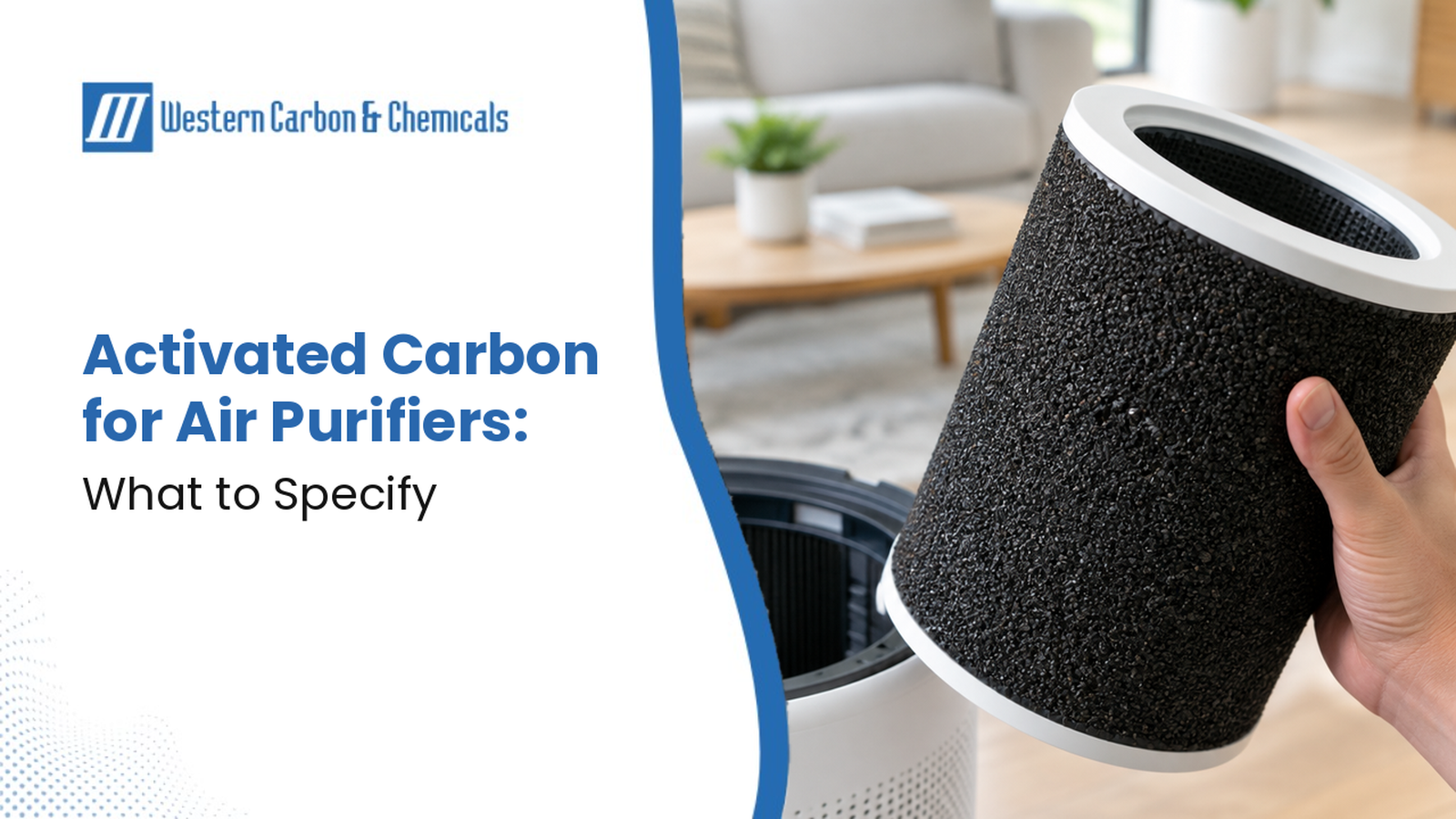
Walk through any air purifier aisle and you will see the same claim repeated: activated carbon filter included. What is rarely stated is how much carbon, which grade, and in what bed geometry, and those three details decide whether the carbon does real work or is little more than decoration.
This guide is written for product developers, procurement teams and engineers who need to specify carbon for a purifier or air-handling unit. It explains what to ask for and why, using the same terms a carbon supplier will use. Western Carbon supplies extruded carbon pellets and granular carbon for this purpose, and our earlier guide on carbon air filters for VOC and odour control covers the broader mechanism.
1. Why Purifiers Need Carbon as Well as a Particle Filter
Air pollution comes as particles and as gases. A pleated or HEPA-type filter captures particles such as dust, pollen and smoke particulates, but gas molecules pass straight through it because they are far smaller than the filter pores. Cooking odours, solvents from paints and cleaning products, and many combustion by-products are gases, and they need an adsorbent.
Activated carbon fills that role. The US EPA notes in its guidance on air cleaners and air filters that cleaners differ in the pollutants they handle, and that those designed for particles are not designed for gases. A purifier that claims to handle odours and volatile organic compounds therefore depends on how much carbon it contains and how well the air contacts it. In practice this means two purifiers with identical particle ratings can differ enormously in how they handle cooking smells, new-furniture emissions or paint fumes, and the difference is almost entirely the carbon stage.
2. How Activated Carbon Captures Gases in Air
Adsorption is the mechanism. Gas molecules passing through a bed diffuse into the carbon pores and are held on the internal surface. The effect is strongest for larger, less volatile organic molecules, and weaker for very small, very volatile ones, and for polar inorganic gases such as ammonia and formaldehyde.
Two factors control real performance. The first is capacity, the mass of contaminant a given mass of carbon can hold. The second is kinetics, how quickly the molecules reach the pores while the air is moving through the bed. In a purifier the air residence time in the carbon is short, often a fraction of a second, so kinetics can limit performance even when the capacity is high. This is also why a carbon that looks excellent on a laboratory capacity test can underperform in a compact purifier: the test lets the gas equilibrate for a long time, while the purifier gives it a fraction of a second. This is why particle size and bed depth matter as much as the quality of the carbon itself.
Seals and housings matter more than most buyers expect. If air can bypass the carbon through gaps at the frame, the filter will measure well on a bench and perform poorly in the room. A tight gasket, a rigid frame and a bed that does not settle over time are simple features that protect the performance the carbon was chosen to deliver.
3. What to Specify: The Core Carbon Parameters
A useful carbon specification for air work contains a small number of measurable properties. Each answers a specific question about how the carbon will behave.
| Parameter | What it indicates | Why it matters in a purifier |
|---|---|---|
| Carbon tetrachloride (CTC) activity or butane activity | Capacity for organic vapours | Best single predictor of solvent and VOC capacity |
| Iodine number | Micropore surface area | General capacity indicator, not vapour-specific |
| Hardness or abrasion number | Resistance to breakage | Limits dust generation and bed settling in transport and use |
| Mesh size or pellet diameter | Particle size distribution | Balances kinetics against pressure drop |
| Bulk density | Mass per unit volume | Sets how much carbon fits in the available filter volume |
| Moisture content | Water carried as supplied | Affects the true carbon mass you are buying |
| Ash content | Mineral impurities | Lower ash is cleaner and gives better capacity per gram |
The distinction between iodine number and vapour activity deserves attention because suppliers often quote iodine number alone. Our note on iodine number versus BET surface area explains why a headline figure may not predict how a carbon behaves on gases.
4. Carbon Weight, Bed Depth and Contact Time
The most common specification failure is not carbon quality but quantity. A thin sheet with a light dusting of carbon powder looks like a carbon filter but contains grams of adsorbent, which can saturate within days in a polluted room. A filter with hundreds of grams or several kilograms of granular or pelletised carbon in a real bed has orders of magnitude more capacity.
Sizing by contact time
Contact time is the bed volume divided by the airflow. For gas removal in compact purifiers, designers aim to give the air as long a path through the carbon as practical without choking the fan, because longer contact allows more molecules to reach the pores. Doubling bed depth roughly doubles contact time but also raises pressure drop, so the fan curve must be checked. The World Health Organization air pollution resources underline why gases and particles must both be addressed, which is the practical argument for designing the carbon stage properly instead of treating it as an add-on.
Questions to ask for any carbon filter
- How many grams of carbon are in the filter, and of what grade?
- What is the bed depth and the face velocity at rated airflow?
- What is the pressure drop at rated airflow?
- What gases was it tested against, and at what concentration?
If a supplier cannot state the carbon weight, treat the carbon claim with caution. Weight is the quickest first check on how much gas capacity a filter really offers.
5. Granular, Pellet and Bonded Carbon: Choosing the Form
The physical form changes pressure drop, dust and manufacturing options. Extruded pellets are cylindrical and pack with consistent voids, giving low and predictable pressure drop and good mechanical strength. They suit deeper beds and larger units, and are the usual choice in industrial vapour-phase work as described in extruded carbon for air purification.
Granular carbon in mesh sizes such as 4×8, 6×12 or 8×16 is common in panel filters and canisters. A narrower size range packs more uniformly, and a slightly finer mesh adsorbs faster at the price of higher resistance to airflow. Bonded or sheet carbon, where powdered carbon is fixed to a substrate, allows thin low-resistance filters but carries far less carbon per unit of face area.
For a comparison of the forms and their trade-offs, see the forms of activated carbon.
Need a carbon specification for your purifier?
Tell us the target gases, airflow and filter volume and Western Carbon will propose a grade, mesh and bed design.
6. Impregnated Carbon for Formaldehyde, Acid Gases and Ammonia
Plain carbon is excellent for many organic vapours but holds small polar molecules weakly. Formaldehyde, ammonia, hydrogen sulphide and acid gases such as sulphur dioxide usually need chemically treated media. Impregnated carbons carry a reactive chemical that binds the target gas, and blended media combine carbon with other adsorbents to broaden coverage.
Matching the impregnation to the gas is essential, and the wrong choice can break through early. Hydrogen sulphide in particular is a safety as well as an odour concern, and the OSHA hydrogen sulfide guidance explains why it should be controlled at source where possible, not only filtered.
Key point: if a purifier is marketed for formaldehyde or ammonia, ask what media does that job. A plain carbon bed alone is rarely the full answer.
7. Industry Standards, Ratings and Honest Claims
Clean air delivery rate ratings from industry programmes describe particle removal for smoke, dust and pollen. They do not describe gas removal, so a high rating says nothing about carbon performance. For gases, ask for test data against named compounds at stated concentrations and flow rates, and for the carbon weight and bed data discussed earlier.
Regulators also care about what a purifier emits. Some devices that generate ozone or other reactive by-products are restricted, and the US EPA indoor air quality resources provide context for evaluating such claims. A passive carbon bed does not generate by-products, which is one reason it remains a standard approach.
For volatile organic compounds specifically, the EPA overview of volatile organic compounds lists common household sources and is a useful reference for deciding which compounds your product should be tested against.
8. Writing the Specification: A Practical Template
A good purchase specification is short and unambiguous. The following items cover what most buyers need, and a supplier should be able to confirm each in writing.
- Carbon type and raw material, for example coconut shell or coal-based, plain or impregnated.
- Particle size or mesh range, and pellet diameter if extruded.
- Minimum CTC or butane activity, minimum hardness and maximum moisture and ash.
- Quantity per filter in grams, and the bed dimensions.
- Packaging and dust control requirements, since carbon dust is a handling nuisance.
- Certificate of analysis for each batch.
Western Carbon provides batch documentation, and our certifications page outlines the quality systems behind it. For related quality terms, see our guide to granular carbon mesh size.
9. Maintenance, Saturation and Replacement in Purifiers
Carbon in a purifier cannot be seen to be full. As it saturates, gas removal falls gradually and odours begin to return, which users often notice before any indicator does. Replacement intervals should therefore be based on expected loading and not on appearance.
Heat and humidity both reduce effective capacity, and high humidity competes with organic vapours for pore space. A purifier used in a humid climate, or in a kitchen with frequent cooking vapour, will exhaust its carbon sooner. Manufacturers can help users by printing an expected life for a stated pollutant load, and by designing the housing so that the carbon cartridge can be swapped without disturbing the particle filter. Both small design choices raise the chance that the carbon is actually replaced when it should be. Some manufacturers offer replaceable carbon cartridges for exactly this reason, and a generous bed makes the filter last longer between changes.
A filter that has captured a lot of gas can release some of it again if conditions change, for example when the room warms. This is another reason not to leave saturated carbon in service.
10. Who Specifies Carbon for Air Purification?
Carbon for air purification is specified across consumer, commercial and industrial settings, and Western Carbon supplies media matched to the duty.
- Consumer and commercial purifier manufacturers developing replaceable carbon filters.
- HVAC engineers adding gas-phase filtration to air-handling units.
- Laboratories, hospitals and clean rooms controlling odour and chemical vapours.
- Industrial plants treating process odours before discharge.
Specialised grades are available under the WestFiltrA line, and our applications overview shows how carbon is used across sectors.
11. Related Reading
- A purifier needs a particle filter and a gas-phase adsorbent, since each handles a different pollutant type.
- Ask for the carbon weight and bed depth before trusting any carbon claim.
- Specify CTC or butane activity, hardness, mesh, moisture and ash, not surface area alone.
- Contact time, set by bed depth and airflow, decides gas removal as much as carbon quality does.
- Formaldehyde, ammonia and acid gases need matched impregnated media.
- Plan replacement from expected loading, since saturated carbon gives no visible warning.
12. Frequently Asked Questions
How much activated carbon should an air purifier contain?
There is no single figure because it depends on room size, pollutant load and airflow, but real gas-phase capacity needs hundreds of grams to several kilograms of carbon in a proper bed, not a thin sheet. Always ask for the carbon weight and bed depth, since weight is the fastest indicator of capacity.
Do HEPA filters remove odours and gases?
No. HEPA-type filters capture particles but gas molecules pass through them. Odours, solvents and many combustion by-products are gases and need an adsorbent such as activated carbon, which is why good purifiers combine both filter types.
Which carbon specification matters most for air purification?
For vapours, carbon tetrachloride activity or butane activity is the most relevant capacity indicator, together with hardness, mesh size, moisture and ash. Iodine number is useful but is not specific to vapour adsorption, so it should not be the only figure you use.
Is pellet or granular carbon better for air filters?
Extruded pellets give low, predictable pressure drop and good strength, so they suit deeper beds and larger units. Granular carbon in a narrow mesh range suits panel filters and canisters. The better choice depends on the available volume, fan power and cost.
Can activated carbon remove formaldehyde from air?
Plain carbon holds formaldehyde weakly because it is a small polar molecule. Impregnated or blended media are usually used for formaldehyde, so check what media a purifier uses before relying on it for this specific gas.
How long does carbon last in an air purifier?
Life depends on the pollutant load, airflow, humidity and the amount of carbon. Heavy cooking vapour or solvent use exhausts a small bed quickly, while a large bed in a clean room can last a year or more. Replace on a schedule based on loading, not on appearance.
Does humidity affect carbon performance?
Yes. Water vapour competes with organic vapours for pore space, so high humidity can reduce effective capacity noticeably. Design allowances for humid climates, and replace carbon sooner where moisture and gas loading are both high.
What documents should a carbon supplier provide?
A certificate of analysis for each batch listing activity, hardness, mesh distribution, moisture and ash, along with carbon type and any impregnation. Western Carbon provides batch documentation supported by its quality certifications.