 Summarize this Article with AI
- Carbon filtration design starts from adsorption equilibrium (isotherms) and kinetics, not from vessel catalogues.
- The mass transfer zone, contact time and carbon usage rate decide how long a bed lasts and what it costs.
- Fixed-bed granular carbon and powdered carbon dosing solve different process problems.
- Liquid-phase and gas-phase designs share principles but differ in humidity, velocity and pressure limits.
- Pilot tests on the real stream beat literature data, because competing compounds change capacity.
- Regeneration, disposal and safety are part of the design, not afterthoughts.
- What Is Activated Carbon Filtration?
- Adsorption Equilibrium and Isotherms
- Adsorption Kinetics and Mass Transfer
- The Fixed Bed: Mass Transfer Zone and Breakthrough
- Fixed Bed or Powdered Dosing?
- Liquid-Phase and Gas-Phase Design Differences
- Selecting the Carbon for the Process
- Pilot Testing and Scale-Up
- Regeneration, Economics and Operation
- Who Applies Carbon Filtration Process Design?
- Related Reading
- Frequently Asked Questions
Activated carbon filtration looks like a single technology, but designing it well draws on adsorption science, hydraulics and economics. Engineers who treat it as simply installing a carbon bed often find that the system underperforms or that carbon costs far more than expected. Engineers who understand the process fundamentals can predict removal, choose the right configuration and plan the operating cost before anything is built.
This guide covers those fundamentals at the process level: how adsorption equilibrium and kinetics set performance, how the mass transfer zone moves through a bed, how to choose between fixed beds and powdered dosing, how liquid and gas applications differ, and how pilot testing, regeneration and economics fit in. It complements our practical guides to carbon selection, such as what activated carbon is and the forms of activated carbon, and Western Carbon’s product range is at our products page.
1. What Is Activated Carbon Filtration?
Activated carbon filtration removes dissolved or gaseous substances by adsorption on a porous carbon surface. It is called filtration by convention, but it is a chemical separation, not a physical straining of particles. A carbon bed may incidentally trap some solids, but its purpose is to remove molecules.
It appears in drinking water, wastewater, process liquids, air and gas streams. Typical targets include chlorine, taste and odour compounds, colour, organic chemicals, solvents, odours and certain metals or metal complexes, such as gold cyanide in mining. Our overview of activated carbon in industrial applications shows the breadth.
Because the principle is adsorption, performance depends on three things: the carbon, the contaminant and the conditions. The process designer’s job is to find the combination that gives the required removal at the lowest total cost.
2. Adsorption Equilibrium and Isotherms
At equilibrium, the amount of a substance held on the carbon depends on its concentration in the fluid. This relationship, measured at constant temperature, is the adsorption isotherm. Common mathematical forms are the Freundlich and Langmuir equations. The isotherm tells you the maximum loading the carbon can reach for a given concentration.
This gives two practical results. First, carbon capacity is higher when the inlet concentration is higher, because the carbon equilibrates with the inlet. Second, the capacity at the low outlet concentration you must achieve is much lower than the capacity at the inlet. Designs that ignore this overestimate carbon life.
Measuring isotherms
Isotherms are measured by contacting known masses of powdered carbon with samples of the real stream and measuring the residual concentration after equilibrium. This gives capacity data for the actual water or process liquid, including the effect of competing compounds.
Always run the isotherm on the real stream. In real water, many compounds compete for pores, and the capacity for any one of them is lower than in clean, single-compound tests.
A useful way to frame the whole design is to treat adsorption as a separation with three questions: what must be removed, to what residual, and for how long between changeouts. Every later decision, from carbon type to vessel geometry, is an answer to one of these questions. Skipping any of them is the most common reason that a plant works in the pilot trial and disappoints at full scale.
3. Adsorption Kinetics and Mass Transfer
Equilibrium tells you how much carbon can hold. Kinetics tells you how fast it gets there. Adsorption involves transport through the liquid film around each granule, diffusion through the pore network, and the adsorption step itself. In most carbon systems, one of the diffusion steps is rate-limiting.
This has design consequences. Smaller granules shorten the diffusion path and speed up adsorption, as discussed in granular carbon mesh size. Higher temperature generally speeds diffusion but reduces equilibrium capacity for most compounds. Higher flow reduces the film resistance but also reduces contact time.
Kinetics is the reason contact time matters. A bed with plenty of carbon but too little contact time will let contaminant through, because the molecules do not have time to reach the pores before the fluid leaves.
4. The Fixed Bed: Mass Transfer Zone and Breakthrough
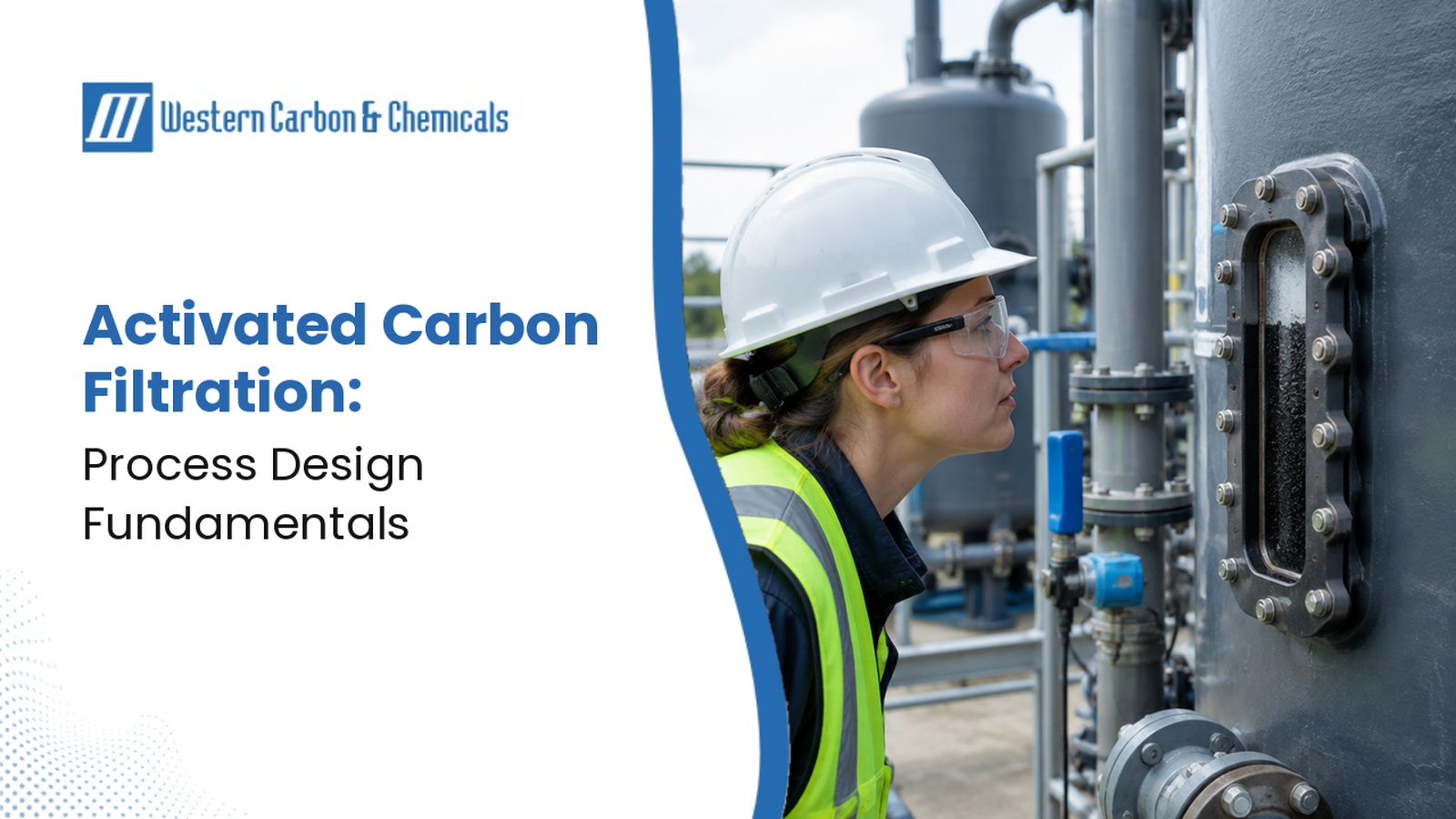
In a fixed bed, fluid flows through a stationary column of granular carbon. The carbon at the inlet saturates first. A band of partly loaded carbon, the mass transfer zone, moves down the bed as the inlet carbon fills. Downstream of that zone the carbon is still clean and the outlet stays clean.
When the front of the mass transfer zone reaches the bottom of the bed, contaminant begins to appear in the outlet. This is breakthrough, and the plot of outlet concentration against volume treated is the breakthrough curve. The bed is considered exhausted when the outlet reaches the allowed limit.
Key point: a shorter mass transfer zone means more of the bed is saturated at breakthrough and the carbon is used more efficiently. Fine mesh, slower flow and strongly adsorbing contaminants all shorten the zone.
Two vessels in series, with the lead vessel run to exhaustion and the lag vessel protecting the outlet, use carbon most completely. Detailed hydraulic design of such vessels is also treated in the guidance of the American Water Works Association.
Pilot data is worth far more than catalogue numbers. A small column test using the actual water, run until breakthrough, shows the real capacity, the shape of the breakthrough curve and the effect of competing compounds in a way that no isotherm can fully predict. Even a short trial of a few weeks, with samples taken at several bed depths, greatly reduces the risk when scaling to production.
5. Fixed Bed or Powdered Dosing?
Carbon can be used in two main modes. In a fixed bed, granular carbon sits in a vessel. In dosing, powdered carbon is mixed into the fluid and then removed by settling or filtration. Each suits different problems.
| Factor | Fixed bed (GAC) | Powdered carbon dosing (PAC) |
|---|---|---|
| Best for | Continuous, steady contaminants | Intermittent or seasonal problems |
| Capital cost | Higher, vessels and valves | Low, dosing and mixing equipment |
| Carbon cost | Lower per unit treated at steady load | Higher per unit, carbon used once |
| Carbon use efficiency | High in series beds | Lower, single-pass contact |
| Removal | High and consistent | Depends on dose and contact time |
| Waste | Spent carbon, regenerable | Carbon sludge to be handled |
Dosing is flexible and well suited to occasional taste and odour events, as explained in powdered carbon treatment and choosing powdered activated carbon. For effluent duty, see powdered carbon in wastewater treatment.
Designing a carbon filtration process?
Share the stream, targets and flow and Western Carbon will help with grade, contact time and configuration.
6. Liquid-Phase and Gas-Phase Design Differences
The principles are the same for liquids and gases, but the practical design differs. In liquid-phase work, hydraulic loading is moderate, beds are often backwashed, and the main concerns are competing organics and fouling by solids. See granular carbon for water treatment.
In gas-phase work, velocities are higher, pressure is low, so pressure drop is critical, and humidity strongly affects capacity because water vapour competes for pores. Coarser granules or extruded pellets are common, as in vapour-phase adsorption with extruded carbon. Heat of adsorption can also raise the bed temperature in strongly loaded gas beds, so monitoring and temperature limits are part of the design.
The US EPA indoor air quality resources and VOC overview give context on gas-phase contaminants, while the ground water and drinking water programme is the equivalent for liquid-phase work.
Hydraulics deserve the same attention as chemistry. Distributors and underdrains must spread flow evenly, otherwise part of the bed is overworked while part sits idle, and breakthrough arrives early at the overloaded zone. Pressure drop should be checked on a dirty bed as well as a clean one, since fines and trapped solids raise it over a run and set the practical limit on throughput.
7. Selecting the Carbon for the Process
Carbon selection follows the contaminant. Small molecules and gases suit micropore-rich carbon such as coconut shell, while larger organics suit broader pore ranges, as in coal or wood-based carbon. The comparison of coconut shell and coal-based carbon covers these trade-offs. Impregnated grades address contaminants that plain carbon holds weakly, such as hydrogen sulphide and some acid gases.
Other specifications matter too: hardness for backwash and regeneration, ash for sensitive products and particle size for hydraulics. The measures behind these are explained in iodine number versus BET surface area. For ash-sensitive duty, acid-washed carbon is an option.
Also Read: Raw Materials of Activated Carbon
8. Pilot Testing and Scale-Up
Laboratory isotherms give capacity, and column tests give breakthrough behaviour. A small column, loaded with the real carbon and fed with the real stream, produces a breakthrough curve that can be scaled to full size. Rapid small-scale column tests are a standard approach for this.
Pilot tests should run long enough to capture the breakthrough, and ideally through the seasonal or process variation the full plant will see. A pilot that runs only on clean winter water will not predict summer performance. The data gives the carbon usage rate, the mass of carbon consumed per volume treated, which is the central figure for operating cost.
Where the contaminant is regulated, compare results against the relevant limits, such as the National Primary Drinking Water Regulations for drinking water, and the WHO drinking water quality guidelines for international context.
9. Regeneration, Economics and Operation
Spent carbon can be disposed of, or reactivated thermally where the loading allows. Reactivation restores much of the capacity at a fraction of the cost of new carbon, but each cycle loses some mass and hardness, so a hard carbon is a better starting point. Carbon loaded with hazardous or reactive compounds may need disposal as regulated waste.
Total cost has several parts: capital cost of vessels and internals, carbon cost, which is usage rate times carbon price, regeneration or disposal cost, and operating cost for pumping and backwash. A cheaper carbon with a lower capacity may cost more per volume treated, so compare on cost per volume treated, not on price per kilogram.
Safety is part of the design. Wet carbon can deplete oxygen in closed vessels, so confined-space controls apply; see the OSHA confined spaces resources. Dust control and ignition-source control apply to dry carbon handling.
A running system needs monitoring. Measure outlet concentration of the target contaminant on a schedule matched to risk, record pressure drop, and track the volume treated. These data confirm that the bed is behaving as predicted, and give early warning of breakthrough.
Operational problems tend to be hydraulic or fouling related: channelling from poor distribution, blinding from solids, biological growth in warm, nutrient-rich beds, and carbon loss through underdrains. Our guide to when to replace an activated carbon filter lists practical symptoms.
Western Carbon’s certifications page outlines the quality systems that support consistent media.
Operating practice should be written into the design from the outset. That means defining sampling points, alarm limits, backwash triggers and the criteria for calling a changeout, so that operators are not forced to improvise. A plant that documents these rules, and reviews the data every few months, usually extracts noticeably more life from each fill of carbon.
10. Who Applies Carbon Filtration Process Design?
Carbon filtration design is applied by process engineers across industries, and Western Carbon supports each of them.
- Water and wastewater utilities and treatment designers.
- Chemical, food, beverage and pharmaceutical process engineers.
- Mining operators using carbon for gold recovery.
- Environmental engineers treating air, gas and groundwater.
Relevant lines include WestAqua, WestOilPure and WestPharm, and the applications overview shows more sectors.
11. Related Reading
- Design from isotherms and kinetics measured on the real stream, not from catalogues.
- The mass transfer zone and carbon usage rate decide bed life and operating cost.
- Use fixed beds for steady loads and powdered dosing for intermittent problems.
- Gas-phase design is dominated by pressure drop, humidity and heat of adsorption.
- Pilot tests that capture seasonal variation turn estimates into dependable designs.
- Include regeneration, disposal and safety in the design and the cost comparison.
12. Frequently Asked Questions
What is an adsorption isotherm?
It is the relationship between the amount of a substance held on the carbon and its concentration in the fluid at equilibrium and constant temperature. It gives the carbon’s capacity at a given concentration, and is measured on the real stream to include the effect of competing compounds.
What is the mass transfer zone in a carbon bed?
It is the band of partly loaded carbon that moves down a fixed bed as the carbon fills. Breakthrough occurs when it reaches the bottom of the bed. A shorter zone means the carbon is used more efficiently.
What is carbon usage rate?
It is the mass of carbon consumed per volume of fluid treated. It is the central figure for operating cost, and is found from isotherm, column or pilot data. Compare carbons on cost per volume treated, not price per kilogram.
When should I use powdered carbon instead of a fixed bed?
Powdered carbon suits intermittent or seasonal problems, such as occasional taste and odour events, because it needs little capital and is dosed only when needed. Fixed beds suit steady loads, where they give more consistent removal and lower carbon cost per volume treated.
Why does humidity matter in gas-phase carbon?
Water vapour competes with organic vapours for pore space, so high humidity reduces capacity. Gas-phase designs allow for this, and may use drying or oversized beds in humid conditions.
Why run a pilot test?
Real streams contain many compounds that compete for the carbon, so literature capacity is often optimistic. A pilot on the real stream gives breakthrough data and carbon usage rate, and should cover the seasonal or process variation the full plant will see.
Can spent carbon be regenerated?
Often, by thermal reactivation, when loaded with suitable organics. Each cycle loses some mass and hardness, so hard carbon is preferred. Carbon loaded with hazardous or reactive compounds may need disposal as regulated waste.
What safety issues apply to carbon filtration?
Wet carbon can deplete oxygen in closed vessels, so confined-space controls apply. Dry carbon dust needs control, and carbon loaded with reactive or flammable substances can self-heat. Follow the applicable regulations and occupational safety guidance.