 Summarize this Article with AI
- Granular activated carbon (GAC) is loose media in a bed, while a carbon block is compressed carbon bonded into a solid shape.
- GAC suits higher flows, deep beds and backwashable systems, and carbon blocks suit compact point-of-use cartridges.
- Blocks give long, uniform contact paths and also filter fine particles, but they clog sooner and flow less.
- GAC beds can channel if poorly designed, and blocks resist channelling because the path is fixed.
- Neither is better in general, and the right choice depends on flow, space, water quality and maintenance.
- Combining a sediment stage, a block or GAC stage and a membrane is common in real systems.
- What Is GAC and What Is a Carbon Block?
- How Each Format Handles Water
- Head-to-Head Comparison
- Contaminant Removal: Does Format Change What Is Removed?
- Flow, Pressure Drop and Space
- Channelling, Fouling and Life
- Cost and Maintenance
- Which to Choose for Which Application
- Combining the Two in One System
- Who Chooses Between Block and GAC?
- Related Reading
- Frequently Asked Questions
Few questions in water treatment cause more confusion than carbon block or granular activated carbon. Both are activated carbon, both remove chlorine and organics, and both are sold as a carbon filter. They are not interchangeable, though, and picking the wrong one leads to low flow, short life or disappointing water.
This guide compares the two on structure, performance and practicality, then maps them to the applications where each is the better answer. Western Carbon supplies the carbon that goes into both formats, including granular activated carbon and extruded carbon. For background on how carbon removes contaminants in the first place, see what activated carbon is.
1. What Is GAC and What Is a Carbon Block?
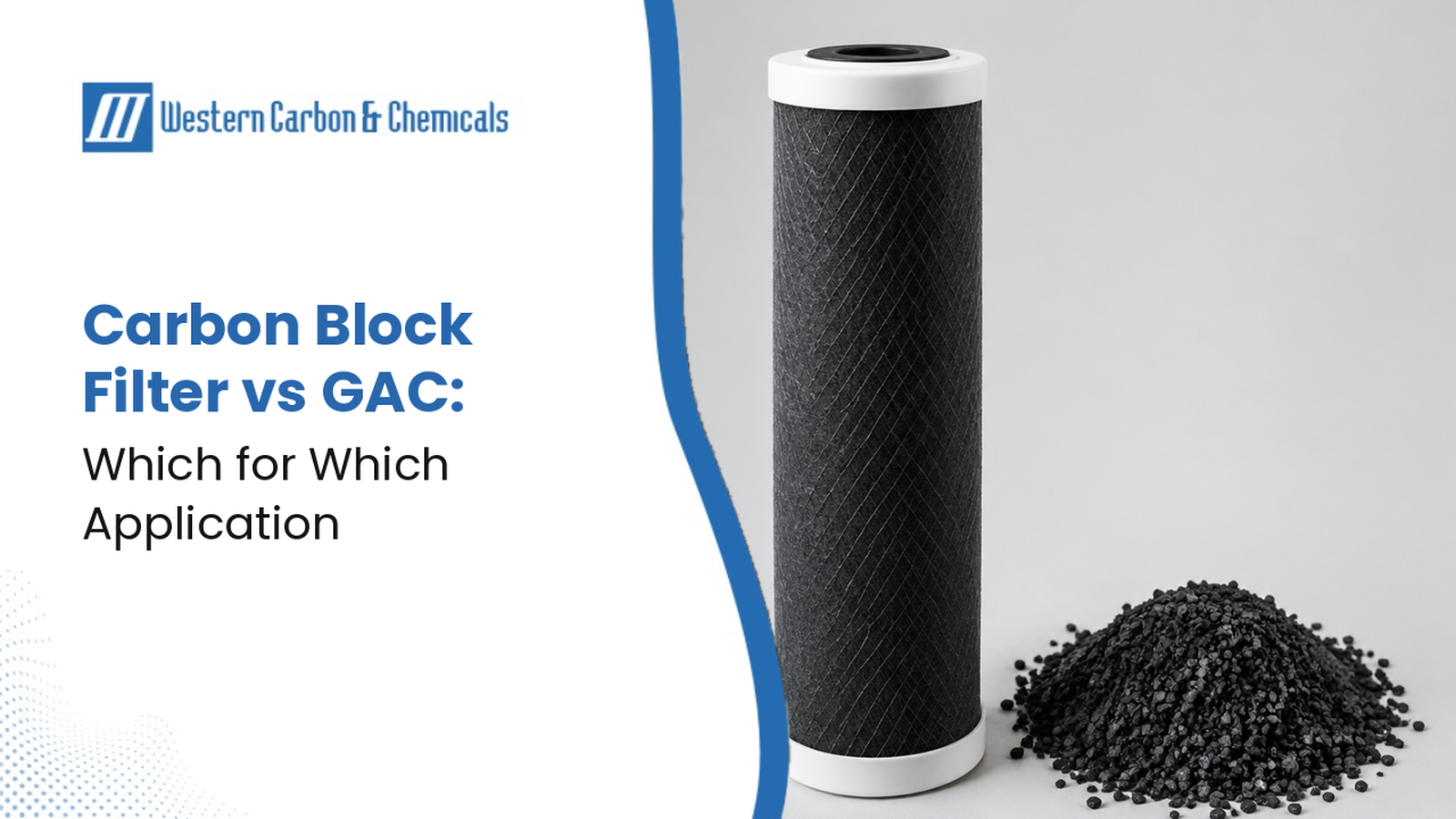
Granular activated carbon is loose, irregular granules of carbon, typically in a mesh range such as 8×30 or 12×40. It is loaded into a tank or cartridge, and water flows through the spaces between the granules. It can be backwashed, topped up or replaced as needed.
A carbon block starts as fine or powdered carbon mixed with a food-grade binder, then pressed or extruded into a solid cylinder and often wrapped in a particle layer. The result is a rigid porous structure through which water is forced. There are no loose granules, so there is nothing to backwash or to shift.
The chemistry is the same, since both rely on adsorption in the carbon pores. The difference is how water meets the carbon, and that changes almost everything else about the filter.
2. How Each Format Handles Water
GAC: flow through a bed
In a GAC bed, water takes many parallel paths between granules, and the bed depth sets the contact time. The bed can be hundreds of times deeper than a cartridge wall, which allows very high capacity. Flow is relatively free, so pressure drop is modest, which is why GAC is the standard in municipal plants and large vessels as covered in granular carbon for water treatment.
Carbon block: flow through a wall
In a block, water crosses the porous wall from outside to inside, and the dense structure forces it close to the carbon over a long path. The fine particle size speeds up adsorption, so a thin wall can achieve good removal in a short time. The same density provides mechanical filtration, and many blocks have a rating of a few microns. Because the wall is thin, a block depends heavily on the fineness of its carbon: the finer the particles, the faster the adsorption, but the higher the resistance to flow. Manufacturers therefore balance particle size, binder content and wall thickness to hit a target flow rate, and two blocks that look identical can perform very differently.
A rule of thumb: GAC buys capacity and flow with depth, and blocks buy kinetics and particle filtration with fine structure.
Replacement planning differs between the two as well. A granular bed is changed in bulk, often by vacuum or by gravity out of the vessel, and the spent carbon can be sent for reactivation where the economics allow. A block cartridge is swapped as a whole unit, which is quick and clean but leaves little to recover, so the cost per change and the labour involved should both be counted when comparing options.
3. Head-to-Head Comparison
The table below sets out how the two compare on the factors that most often decide the choice.
| Factor | Granular activated carbon | Carbon block |
|---|---|---|
| Flow rate | High, low pressure drop | Lower, higher pressure drop |
| Contact path | Set by bed depth | Long, uniform path through the wall |
| Particle filtration | Poor, not designed for it | Good, often rated in microns |
| Channelling risk | Possible if poorly designed or fouled | Low, fixed structure |
| Backwashing | Yes, in vessels | No, replace when spent |
| Carbon capacity per unit | Very high in deep beds | Limited by cartridge size |
| Typical use | Municipal, industrial, whole-house | Under-sink, countertop, point-of-use |
| Replacement | Media change or top-up | Whole cartridge swap |
Also Read: Benefits of Activated Carbon Filters
4. Contaminant Removal: Does Format Change What Is Removed?
Not fundamentally. The set of chemicals adsorbed depends on the carbon, its pore structure and any impregnation, not on whether it is shaped as granules or a block. What format changes is how efficiently the carbon is used and how reliably the water is treated across its life.
Blocks are favoured for removing fine particles together with chemicals, which is why many certified cartridges address chlorine and particulate claims in a single unit. Some blocks are formulated for lead reduction, which plain GAC does not reliably do. Independent certification, as described in the standards from NSF for drinking water treatment units, is the sound way to verify such claims.
For general contaminants, the US EPA’s drinking water treatability database records how carbon performs for individual compounds, and applies to both formats at the level of the carbon itself. In practice the sensible workflow is to identify the target compound, check that carbon removes it at all, and only then decide whether a block or a bed is the better way to deliver the carbon to the water.
5. Flow, Pressure Drop and Space
Because a block forces all the water through a dense wall, its flow rate is limited, and its pressure drop is higher than a GAC bed of equivalent capacity. Under-sink units give a gentle flow suited to a single tap, and they run slowly when the cartridge is partly blocked. A GAC vessel, in contrast, can pass many gallons per minute with little loss. This is also why it is risky to swap a cartridge-style block into a system designed for a freer-flowing filter: the extra resistance can starve taps and appliances, and the pump or mains pressure may not compensate.
Space shows the other side of the trade. A cartridge fits in a cabinet or a countertop housing, while a GAC vessel needs a floor area, a drain for backwash and a control valve. For a building supply, there is no practical way to put enough carbon in a block cartridge, so GAC is the only realistic choice. For a kitchen tap, a block is usually the only practical one.
Key point: choose by flow and space first. If you need more than a trickle of treated water, or treat a whole building, you are almost certainly designing a GAC system.
Choosing between a block and a GAC bed?
Tell us flow, space and water quality and Western Carbon will recommend a carbon format and grade.
6. Channelling, Fouling and Life
GAC beds can channel when the bed is poorly packed, the flow distribution is uneven or the media is fouled, and water then bypasses most of the carbon. Good vessel design, correct packing and periodic backwash prevent this. A carbon block resists channelling because the path is fixed, but it clogs more readily, since its fine pores trap sediment and scale.
Life depends on the load. A block in clean water can last months, while in sediment-laden water it may block within weeks unless a pre-filter is fitted. A GAC bed protected by a pre-filter can run for years on chlorine duty. Our guide to when to replace an activated carbon filter covers the signs for both.
Why a pre-filter helps both
A sediment pre-filter protects blocks from clogging and GAC beds from coating. It is cheap, easy to replace and frequently the difference between a carbon filter that lasts and one that fails early. In hard or iron-rich water, scale and iron precipitates behave like sediment as far as the carbon is concerned, so water with these issues deserves an upstream stage matched to them instead of relying on the carbon to cope.
7. Cost and Maintenance
On a per-unit basis, a block cartridge is cheap and simple to replace, which suits households and small offices. Over time, cartridge replacement is a recurring cost, and it is easy to neglect. GAC in a vessel has a higher upfront cost for the tank and valve but lower media cost per volume of water treated, particularly at scale.
Maintenance routines differ. Cartridges are replaced on a calendar or when flow drops, and many users replace them late because there is no obvious signal that the carbon is spent. A simple habit of writing the installation date on the housing, and replacing on that date, avoids most problems. GAC beds are backwashed on a schedule and the media is changed when outlet testing shows breakthrough. Both benefit from outlet testing, which the EPA ground water and drinking water programme and CDC water resources both encourage as part of managing water quality.
For private or unusual water supplies, test the water first. Filters cannot be chosen sensibly without knowing what is in the water.
8. Which to Choose for Which Application
The following matches typical applications to the better-suited format, assuming standard conditions.
| Application | Better choice | Reason |
|---|---|---|
| Under-sink or countertop drinking water | Carbon block | Compact, long contact path, fine particle filtration |
| Refrigerator and appliance filters | Carbon block | Small space, low flow, fixed structure |
| Whole-house point-of-entry | GAC | High flow and large carbon volume needed |
| Municipal or community water | GAC | Deep beds, backwashable, large capacity |
| Pre-treatment for reverse osmosis | GAC or block | GAC for larger systems, block for small units |
| Industrial process water | GAC | High flow, regeneration or replacement of bulk media |
| Wastewater or effluent polishing | GAC or powdered carbon | Bulk treatment at scale |
For reverse osmosis protection, see activated carbon in RO systems. For effluent duty, see powdered carbon in wastewater treatment, which uses carbon in a different form again.
9. Combining the Two in One System
Many well-designed systems use both. A sediment stage removes particles, a GAC or block stage removes chlorine and organics, and a membrane or ion exchange stage removes dissolved salts. In small reverse osmosis units the carbon block commonly serves as both the chlorine remover and the final particle filter.
For larger systems, GAC beds are often followed by cartridge polishing, and oxidation media such as manganese dioxide or filtration media such as anthracite may be placed upstream. The point is to match each stage to a job, instead of asking one filter to do everything. A common failure pattern is the single filter asked to remove sediment, chlorine, organics and microbes at once, which ends up clogged, exhausted or both. Splitting the duty gives each stage a long and predictable life. Technical resources from the American Water Works Association offer more on how stages are combined at plant scale.
10. Who Chooses Between Block and GAC?
The decision comes up across a range of buyers, and Western Carbon supplies carbon and advice for each.
- Appliance and cartridge manufacturers choosing formats for new products.
- Water treatment dealers specifying systems for homes and businesses.
- Industrial users selecting pre-treatment for membranes and boilers.
- Municipal and community suppliers polishing finished water.
Our WestFiltrA and WestAqua lines cover filtration and water duty, and the applications page maps sectors in more detail.
11. Related Reading
- GAC and carbon block use the same chemistry but differ in how water contacts the carbon.
- GAC suits high flow, deep beds and backwash, and blocks suit compact point-of-use cartridges.
- Blocks add fine particle filtration and resist channelling but clog sooner and flow less.
- Choose by flow and space first, then by water quality and maintenance.
- Verify special claims such as lead reduction through independent certification.
- Combine a sediment stage, a carbon stage and a membrane or ion exchange stage where needed.
12. Frequently Asked Questions
What is the difference between a carbon block and GAC?
GAC is loose granular carbon in a bed, suited to higher flow and backwashing. A carbon block is fine carbon compressed with a binder into a solid cylinder that also filters fine particles. Both adsorb the same chemicals, but they differ in flow, capacity, maintenance and where they are used.
Which is better, carbon block or GAC?
Neither is better universally. Carbon blocks suit compact point-of-use cartridges because of their long contact path and fine particle filtration. GAC suits whole-house, industrial and municipal systems because of its high flow and large carbon volume. The right choice depends on your flow, space and water quality.
Does a carbon block remove more contaminants than GAC?
Not by chemistry, since both rely on the same adsorption. Blocks may achieve better removal per unit of carbon because of their fine structure and fixed path, and some are certified for lead or particles. GAC can match this with sufficient bed depth and contact time.
Can GAC channel and let water bypass the carbon?
Yes, if the bed is poorly packed, the flow distribution is uneven or the media is fouled. Good vessel design, correct bed depth and regular backwash reduce the risk. Carbon blocks resist channelling because the flow path is fixed within the structure.
Why does my carbon block filter clog so quickly?
The fine pores that give a block its good performance also trap sediment and scale. In sediment-rich water a block can clog within weeks. A sediment pre-filter ahead of the block usually extends life considerably.
Can I backwash a carbon block?
No. Blocks are replaced when spent or clogged. GAC beds in vessels can be backwashed to remove fines and sediment, which is one reason they suit larger systems.
Which is better for reverse osmosis pre-treatment?
Small RO units commonly use a carbon block for chlorine removal and particle filtration. Larger RO systems typically use GAC vessels because of the flow rates involved. In both cases the carbon protects the membrane from chlorine damage.
Is GAC or carbon block cheaper to run?
A block cartridge is cheap to buy and simple to replace, which suits households. GAC has a higher upfront cost for the vessel and valve but a lower media cost per volume treated at scale. Over the life of a system the comparison depends on flow and maintenance.